Are Automatic Driving Lessons Easier? 7 Reasons Learners Find Them Less Stressful
A Burton / Swadlincote Driving Guide from OMG! I'm Driving.
Driving lessons with some of the highest pass rates in the area.

Are Automatic Driving Lessons Easier?
7 Reasons Learners Find Them Less Stressful
There's a moment during almost every learner driver's first few lessons when everything seems to happen at once.
You're approaching a junction. Your instructor reminds you to check your mirrors. There's a car behind you, a pedestrian near the crossing, and you're trying to remember whether you should be in second gear.
Then comes the clutch.
Too much. Not enough. The car judders. Your confidence takes a knock.
Sound familiar?
If you've been wondering, are automatic driving lessons easier than manual lessons?, you're asking a question thousands of new drivers have considered before getting behind the wheel.
And there's some encouraging news.
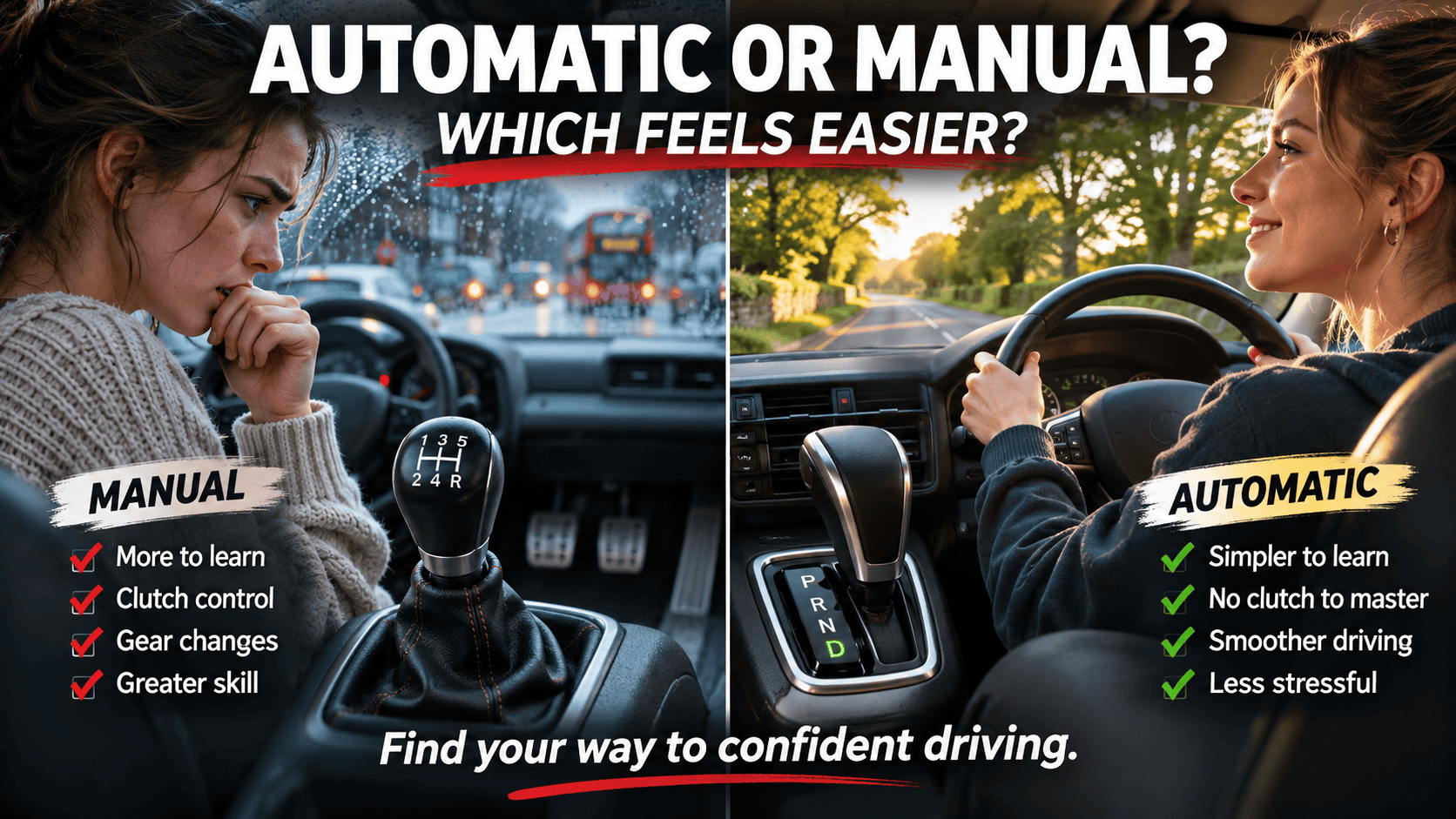
Yes, automatic driving lessons are generally easier for beginners because you don't have to operate a clutch pedal or change gears manually. With fewer controls demanding your attention, you can spend more time concentrating on steering, traffic, road positioning and developing safe driving habits.
That doesn't mean learning to drive becomes effortless. There are still roundabouts to negotiate, hazards to recognise and decisions to make. But removing the constant worry about clutch control can make those first few lessons feel considerably less daunting.
For some learners, that small change makes a surprisingly big difference.
So, what does learning to drive automatic actually feel like? And is it the right choice for you?
Let's look at what changes when you take the gears out of the equation.
Are Automatic Driving Lessons Easier Than Manual Lessons?
Imagine trying to learn two new skills at once.
One requires you to understand the road: spotting hazards, reading signs, judging distances and anticipating what other drivers might do.
The other involves operating a machine: coordinating your feet, selecting gears and getting the timing right every time you move away or slow down.
That's essentially what happens during your first manual driving lessons.
You're learning how to drive safely while also learning how to operate a manual gearbox.
In an automatic car, one of those challenges becomes much simpler.
The vehicle changes gears automatically as you drive. There's no manual clutch pedal to operate, and you don't need to keep selecting gears as your speed changes.
You still control the accelerator, brakes and steering. You'll still need to watch your surroundings and respond appropriately to other road users.
But there's less mechanical coordination involved.
That's why automatic driving lessons can feel easier, particularly when you're just starting out.
Instead of thinking, "What gear should I be in?", you can give more attention to questions that really matter:
Is that pedestrian about to cross? Am I travelling at a safe speed? Have I checked my mirrors? Is there enough space to pull out?
And once those decisions start feeling more natural, driving can become a lot more enjoyable.
7 Reasons Automatic Driving Lessons Can Feel Less Stressful
There's something reassuring about getting into a car and discovering that driving doesn't have to involve quite as many moving parts as you imagined.
Automatic lessons simplify some of the things that learners tend to find most frustrating.
Here are seven reasons why.
1. You Can Forget About Finding the Biting Point
Ask a group of learner drivers what they struggled with most, and sooner or later someone will mention the biting point.
It's that delicate moment when you begin releasing the clutch and the car starts to move.
Get it right, and everything feels smooth.
Get it wrong, and the car might judder, stall or refuse to move as expected.
Learning clutch control takes practice. You need to develop a feel for how the car responds while coordinating the clutch and accelerator.
Then you have to repeat that process at junctions, traffic lights and on hills.
For some learners, it clicks fairly quickly. Others spend lesson after lesson trying to get comfortable with it.
When you're learning to drive an automatic car, there's no manual clutch pedal to worry about.
You select the appropriate driving mode, use the brake and accelerator correctly, and the car manages the gear changes.
Of course, you still need to learn how the vehicle responds. Smooth braking and controlled acceleration remain essential.
But you won't spend your first lessons searching for a biting point.
And if clutch control is the thing that's been making driving feel impossible, that's a pretty welcome change.
2. Changing Gears Is One Less Thing on Your Mind
Picture yourself driving along a quiet road.
You're feeling comfortable. The steering is going well, you're maintaining a sensible speed, and you're beginning to enjoy the experience.
Then your instructor asks you to turn left.
Suddenly, you have several things to remember.
Check your mirrors. Signal when appropriate. Slow down. Choose the correct gear. Watch for pedestrians. Position the car safely.
It's not that any one of these tasks is necessarily impossible.
It's having to think about all of them together.
In a manual vehicle, gear selection becomes second nature with experience. During those early lessons, though, it can demand a surprising amount of concentration.
An automatic car takes care of changing gears for you.
You'll still need to understand the gear selector, including positions such as Park, Reverse and Drive. But you won't be shifting between driving gears every time you accelerate or approach a junction.
That leaves you with fewer decisions to make about the car itself.
For beginners, this can make lessons feel less cluttered and more focused.
Instead of worrying about the gearstick, you can start developing the awareness and judgement that make someone a good driver.
3. You Don't Have to Fear Clutch-Related Stalling at Every Junction
You're at a set of traffic lights.
They turn green.
You prepare to move away, knowing the driver behind you is probably expecting you to get going.
And then the engine stalls.
It's not the end of the world. Your instructor knows how to handle it, and stalling is a normal part of learning manual driving.
But that doesn't make it feel any less embarrassing when you're sitting there wishing the car would cooperate.
For nervous learners, the possibility of stalling can become a constant worry.
It can even make approaching junctions feel more stressful than they need to be.
With automatic driving lessons, you don't have to worry about stalling because you've released the clutch incorrectly.
There's no manual clutch pedal for you to operate.
You'll still need to move away safely, judge gaps in traffic and control your acceleration. An automatic vehicle can also stop unexpectedly because of a mechanical problem.
But that familiar manual-learning challenge — getting the clutch timing wrong — disappears.
Imagine approaching a junction and being able to devote your attention to the road rather than worrying about whether the engine will cut out.
For some learners, that's when things begin to feel different.
4. Busy Traffic Doesn't Have to Mean Constant Gear Changes
Slow-moving traffic can test anyone's patience.
For a learner in a manual car, it can also mean a lot of clutch work.
You move forward.
Stop.
Move forward again.
Change gear.
Slow down.
Repeat.
Now add cyclists, parked vehicles, pedestrians and impatient drivers to the situation.
There's plenty to think about before you even consider the gearbox.
Automatic driving lessons can make stop-start driving easier to manage because the vehicle handles gear changes without you needing to operate a clutch.
You still have to pay close attention to what's happening around you.
Following distances matter. Smooth braking matters. Anticipating when traffic might stop suddenly matters.
But there's less mechanical work involved in keeping the vehicle moving.
This can be particularly helpful when learning to drive on busy UK roads, where traffic lights, queues, roundabouts and junctions can appear one after another.
It's also worth thinking about where you'll drive after passing your test.
If you expect to spend a lot of time commuting through town or navigating urban traffic, the simplicity of an automatic car may be something you appreciate long after your lessons finish.
5. You Have More Headspace for What's Happening on the Road
Here's something that often gets overlooked when people compare automatic vs manual driving.
Controlling the car is only one part of learning to drive. Understanding the road is the bigger challenge.
You need to recognise hazards before they become problems.
You have to notice pedestrians waiting near crossings, cyclists travelling alongside parked cars and vehicles that might change direction without warning.
You also need to make safe decisions without relying on someone to tell you what to do.
These skills take time to develop.
And they're essential whether you learn in a manual or automatic car.
The advantage of automatic lessons is that you aren't constantly dividing your attention between the road and manual gear control.
That doesn't automatically make you more observant.
But it may give you more mental space to practise becoming observant.
Take a busy roundabout, for example.
Instead of thinking about selecting the correct manual gear while slowing down, you can give more attention to your approach speed, road markings, traffic and whether it's safe to enter.
You'll still need plenty of practice. Judging gaps and understanding other road users are learned skills.
But there's something valuable about being able to focus on those skills without worrying about what your left foot should be doing.
And gradually, the roads that once felt overwhelming can start making more sense.
6. Hill Starts Feel Less Like a Test of Your Coordination
Few things make a new manual driver more uncomfortable than stopping halfway up a steep hill.
Especially when there's another vehicle close behind.
You know you need to move away safely.
But you're also thinking about the clutch, accelerator, brakes and the possibility of rolling backwards.
Get the timing wrong, and the car may stall.
It's a skill that becomes easier with practice, but it can be intimidating while you're learning.
In an automatic car, there's no manual clutch coordination involved.
You still need to understand how to control the car on a slope. Automatic vehicles aren't immune to rolling, and different models have different features.
Some modern cars have hill-start assistance or brake-hold systems that can help prevent unintended movement for a short period.
Your instructor will explain how the particular vehicle works and show you how to move away safely.
The important difference is that you won't have to balance a manual clutch and accelerator to get moving.
That can make hill starts feel more approachable.
Not because hills stop being something you need to respect, but because the process of controlling the car is less complicated.
7. Confidence Can Come More Naturally When There's Less to Juggle
There's a quiet moment in learning to drive that doesn't get talked about enough.
It's the moment you realise you've just done something that frightened you a few lessons earlier.
Perhaps you've negotiated a roundabout without feeling overwhelmed.
Maybe you've handled a busy junction, parked successfully or driven along an unfamiliar road while staying calm and in control.
You notice it afterwards.
I actually did that.
Those small achievements matter.
For many nervous learners, the biggest obstacle isn't a lack of ability. It's the feeling that driving involves too many things happening at once.
Automatic lessons can help reduce that initial pressure.
With fewer mechanical tasks to coordinate, some learners find they can settle into the driving experience more comfortably.
And as they begin making progress, their confidence grows.
That confidence won't appear overnight.
You might have a lesson where everything goes smoothly, followed by another where a difficult junction leaves you feeling unsure again.
That's normal.
Learning rarely happens in a straight line.
What matters is having an instructor who helps you understand your mistakes, gives you time to practise and introduces new challenges when you're ready.
Automatic driving lessons for beginners can provide a simpler starting point, but it's the combination of good teaching, patience and experience that helps turn a nervous learner into a capable driver.
You don't have to feel confident before you begin.
Sometimes, confidence comes from discovering what you're capable of.
Automatic vs Manual Driving Lessons: Which Is Actually Easier?
By now, the difference in vehicle control might seem fairly clear.
But choosing between automatic and manual driving lessons isn't simply a matter of deciding which one feels easier.
You also need to think about the kind of car you'll want to drive after passing, the flexibility you need and how comfortable you feel with each option.
Here's how the two compare.
| What you're learning | Automatic driving lessons | Manual driving lessons |
|---|---|---|
| Clutch control | No manual clutch pedal | Requires practice and coordination |
| Gear changes | Handled automatically | Driver selects gears manually |
| Moving away | Fewer controls to coordinate | Clutch and accelerator coordination required |
| Stalling | No clutch-related stalling | Can happen when clutch control is incorrect |
| Hill starts | No manual clutch coordination | Requires careful clutch, brake and accelerator use |
| Stop-start traffic | Usually simpler mechanically | More frequent clutch and gear use |
| Driving-test standards | Same essential safety standards | Same essential safety standards |
| Licence entitlement | Automatic vehicles only | Normally covers manual and automatic cars |
Is Automatic Easier Than Manual for Complete Beginners?
For many people, yes.
The simpler controls can make those first lessons more manageable, particularly if you've never operated a vehicle before.
But that doesn't mean everyone finds manual driving difficult.
Some learners enjoy the extra involvement of changing gears and become comfortable with the clutch quite quickly.
Others decide they'd rather concentrate on driving without that additional coordination.
Neither choice says anything about how capable you'll be once you've passed your test.
The more useful question is: Which type of driving lesson will suit the way you learn and the cars you expect to use?
What Do You Give Up by Choosing Automatic?
The main trade-off is your driving licence.
If you pass your practical test in an automatic car, you'll normally receive a licence that only allows you to drive automatic vehicles.
In the UK, restriction code 78 identifies this automatic-only entitlement.
Pass in a manual car, however, and you can normally drive both manual and automatic vehicles within the same licence category.
It's worth considering.
If your family car is manual, you may want the flexibility to drive it. The same applies if you expect to use manual vehicles for work.
On the other hand, if you're planning to drive an automatic car anyway, that restriction might not affect your everyday life.
Related guide: Automatic vs Manual Driving Lessons: Which Should You Choose?
Are Automatic Driving Lessons Easier for Nervous Drivers?
There's a difference between being excited about learning to drive and feeling ready to do it.
You might love the idea of having your own car, driving to work or visiting friends without asking for a lift.
Yet the thought of actually sitting in the driver's seat can still make your stomach tighten.
What if you make a mistake?
What if another driver gets impatient?
What if your instructor thinks you're taking too long to learn?
These worries can make even booking your first lesson feel like a big step.
Automatic driving lessons can help by removing some of the things beginners commonly find frustrating.
You don't have to think about clutch control while approaching a junction or worry about selecting the right manual gear during a turn.
That can make driving feel less overwhelming, especially when you're trying to build confidence.
But choosing an automatic car is only part of the picture.
The Right Driving Instructor Can Make All the Difference
Think about the difference between someone who simply tells you what you've done wrong and someone who helps you understand how to improve.
One approach can leave you feeling tense.
The other gives you something useful to work on.
A good driving instructor understands that people learn differently.
Some learners are ready to tackle busier roads relatively quickly. Others need more time to become comfortable with basic vehicle control.
You might need to practise the same manoeuvre several times before it starts to feel familiar.
That's part of learning, not a reason to rush.
At OMG! I'm Driving, our approach is centred on personalised lessons that take account of each learner's experience, confidence and progress.
Whether you're completely new to driving or considering switching from manual to automatic, the aim is to help you develop the practical skills needed to drive safely and independently.
And if you arrive at your first lesson feeling nervous?
That's something you can talk about with your instructor.
You don't have to pretend otherwise.
How Many Automatic Driving Lessons Will You Need?
It's natural to wonder how long learning to drive will take.
You might already be imagining the day you pass your test, collect your full licence and head out on the road without an instructor beside you.
But between that first lesson and passing your test, there's no universal timetable.
Some learners become comfortable with the basic controls of an automatic car quite quickly.
Others need more time to develop confidence in traffic, handle complicated junctions or make safe decisions independently.
The fact that automatic cars are mechanically simpler doesn't mean every learner will pass sooner.
Your progress will depend on several things:
- Previous experience: Have you driven before, or is everything completely new?
- Lesson frequency: Are you practising regularly or leaving long gaps between lessons?
- Road awareness: How comfortable are you identifying hazards and reading traffic?
- Confidence: Do unfamiliar driving situations make you hesitant?
- Private practice: Can you practise legally with suitable supervision and insurance?
- Consistency: Are you building on what you learned during previous lessons?
There's no minimum number of professional driving lessons you must complete before taking your practical driving test in Great Britain.
The goal isn't to reach a particular lesson number.
It's to reach the point where you can drive safely and independently.
Can Automatic Driving Lessons Help You Pass Sooner?
They might.
Because you don't have to spend time learning clutch control and manual gear changes, you may become comfortable with basic vehicle handling sooner.
For some learners, that means being able to concentrate on other driving skills earlier in their training.
But it's important not to confuse making quicker progress with being ready for a driving test.
You'll still need to handle unfamiliar roads, recognise hazards, negotiate junctions and demonstrate consistent judgement.
Your instructor should help you assess your readiness based on your actual driving ability, not simply how many lessons you've completed.
Are Automatic Driving Lessons Cheaper Overall?
Not necessarily.
Automatic driving lessons can sometimes cost more per hour than manual lessons, depending on your location and instructor availability.
You might need fewer lessons to become comfortable with the vehicle's controls, but there's no guarantee you'll need fewer lessons overall.
That's why it's worth looking beyond the hourly price.
Compare lesson options, consider how frequently you can practise and think about the experience you want from your instructor.
Saving a few pounds on a lesson is less useful if the learning approach isn't right for you.
Related guide: Driving Lesson Prices and Packages
Is the Automatic Driving Test Easier Than the Manual Test?
It's easy to see why learners ask this question.
If the car is easier to control, surely the driving test must be easier too?
Not quite.
Although an automatic car removes manual gear changes and clutch operation, the practical driving test still assesses the same essential standards of safe driving.
Your examiner isn't simply checking whether you can make the car move.
They want to see that you can use the road responsibly, understand what's happening around you and make safe decisions without constant guidance.
You'll need to demonstrate skills such as:
- Checking mirrors and observing your surroundings.
- Maintaining appropriate road positioning.
- Responding correctly to road signs and signals.
- Negotiating junctions and roundabouts safely.
- Controlling your speed and following distances.
- Recognising hazards and reacting appropriately.
- Completing the required reversing manoeuvre safely.
- Driving independently when instructed.
The gearbox doesn't change the importance of these skills.
Do Automatic Learners Have a Better Driving Test Pass Rate?
You shouldn't assume so.
The DVSA publishes practical driving-test statistics, including information about automatic tests.
Pass rates can vary between test centres, time periods and groups of candidates.
And even when figures differ, that doesn't prove the gearbox alone caused the difference.
A learner's preparation, experience and driving ability matter enormously.
Choosing automatic might make it easier for you to concentrate on safe driving, but it won't compensate for poor observation or unsafe decisions.
If you're curious about the figures, the official DVSA driving-test statistics provide a useful starting point.
The best question to ask your instructor isn't necessarily, "How quickly can I take my test?"
It's, "What do I still need to improve before I'm ready?"
That conversation will tell you far more about your progress.
Who Are Automatic Driving Lessons Best Suited To?
One of the biggest misconceptions about automatic lessons is that they're only for people who struggle with manual cars.
They're not.
People choose automatic for all sorts of reasons.
Complete Beginners Who Want a Simpler Introduction
If you've never driven before, the thought of operating a car might feel unfamiliar enough without having to think about a clutch and gearbox.
Automatic lessons let you start with fewer controls to coordinate.
You can learn how to move away, steer, brake and understand the road before gradually taking on more complicated driving situations.
Nervous Learners Who Want to Build Confidence
If you're worried about stalling, dealing with traffic or making mistakes, the simplicity of automatic vehicle control may help you feel more comfortable.
You'll still need to practise the skills that make driving safe, but you won't have the additional challenge of mastering manual gear changes.
Learners Who Have Struggled With Manual Lessons
Perhaps you've already had several manual driving lessons.
You understand road signs, you're becoming better at checking mirrors, and your steering is improving.
But the clutch?
That still leaves you feeling frustrated.
Switching to automatic could be worth considering.
You won't necessarily lose the progress you've made, because many of your road skills transfer directly.
People Planning to Drive Automatic or Electric Cars
If you're intending to buy an automatic car after passing, learning in one makes practical sense.
The same may apply if you're planning to drive an electric vehicle.
Fully electric cars typically don't have conventional manual gearboxes, so the driving experience is generally closer to an automatic car.
Learners Who Prefer a Less Mechanically Demanding Experience
Not everyone wants to operate a manual gearbox.
You might simply prefer the convenience of an automatic car.
That's a perfectly reasonable reason to choose automatic driving lessons.
Learning to drive is about developing the ability to travel safely and independently — not proving you can use a particular type of transmission.
What Really Happens During Your First Automatic Driving Lesson?
The first time you sit in the driver's seat, everything can feel unfamiliar.
The mirrors seem to need adjusting in three different directions.
You're looking at the pedals, wondering where to put your feet.
And there's that unfamiliar feeling of being responsible for a vehicle instead of simply sitting in the passenger seat.
The good news is that your instructor won't expect you to know everything.
You'll Start by Getting Familiar With the Car
Your first lesson will normally begin with an introduction to the vehicle.
Your instructor will explain the main controls and how they're used.
You'll learn where to find the accelerator and brake, how to adjust your seating position, and how to check that your mirrors give you a useful view of the road.
You'll also be introduced to the automatic gear selector.
Common positions include Park, Reverse, Neutral and Drive, although the controls can vary between models.
Don't worry if you don't remember everything straight away.
Your instructor will guide you through what you need to know.
Then You'll Begin Learning How the Car Moves
Depending on your experience and local conditions, your instructor may take you to a suitable quiet area to practise basic control.
You'll learn how to move away safely, steer and bring the vehicle to a controlled stop.
In an automatic, you won't need to coordinate a clutch and manual gearstick during this process.
But you'll need to understand how the car responds to the brake and accelerator, including how some automatic cars creep forward when Drive is selected and the brake is released.
That's why listening to your instructor and learning the vehicle's specific controls is important.
Gradually, You'll Begin Building Real Driving Skills
As your confidence grows, you'll work towards handling more demanding situations.
You might practise approaching junctions, recognising hazards, using mirrors correctly and choosing appropriate road positions.
Eventually, you'll develop the skills needed to drive on a wider variety of roads and deal with everyday traffic.
Every learner reaches these stages at a different pace.
A first lesson isn't a performance.
It's the beginning of learning something new.
And it's completely normal to finish feeling proud of one thing while knowing you've still got plenty to practise.
Can You Switch From Manual to Automatic Driving Lessons?
Yes, and you don't have to think of it as giving up.
Sometimes, learning something new involves discovering which approach works best for you.
You might have started manual lessons because that's what your friends did, because a family member recommended it or because you assumed it was the only sensible option.
Then, after a few lessons, you realise the clutch is taking up most of your attention.
You're progressing with observation and steering, but gear changes keep interrupting your confidence.
Switching to automatic is a practical choice worth discussing with your instructor.
Many of the skills you've learned in a manual car will still be useful.
You'll already have experience with road signs, mirror checks, positioning, traffic awareness and responding to hazards.
The main adjustment is becoming familiar with how an automatic vehicle operates.
What If You Want to Drive Manual Later?
Choosing automatic now doesn't mean you've closed that door forever.
In Great Britain, if you pass your test in an automatic car and later decide you want manual entitlement, you can take a practical driving test in a manual car to upgrade your licence.
You don't need to pass another theory test for that upgrade.
Until you have the appropriate manual entitlement, however, your automatic-only licence won't allow you to drive manual cars independently.
The official GOV.UK automatic-to-manual licence guidance explains the process.
It's worth knowing your options before booking lessons, especially if you think you may need to drive different types of vehicles in the future.
Frequently Asked Questions About Automatic Driving Lessons
I've never driven before. Will automatic lessons be easier for me?
They often are, particularly when it comes to basic vehicle control.
You won't need to learn how to operate a manual clutch or change gears while driving, so you can concentrate on steering, braking, observation and understanding the road.
You won't be expected to know how to drive before your first lesson. Your instructor will introduce new skills gradually.
I'm really nervous about driving. Would automatic help?
It could.
For some nervous learners, having fewer controls to coordinate makes the whole experience feel more manageable.
You won't have to worry about clutch-related stalling or selecting manual gears at every junction.
That said, your instructor's teaching style, your lesson pace and regular practice can be just as important for building confidence.
Will I need fewer lessons if I learn automatic?
Possibly, but there's no guarantee.
Some learners get comfortable with the basic controls more quickly in an automatic car because there's less mechanical coordination involved.
You'll still need to develop safe driving habits, good observation and independent judgement before you're ready for your test.
Are automatic cars easier to drive in heavy traffic?
Generally, yes, from a vehicle-control perspective.
In slow-moving traffic, an automatic car handles gear changes for you. You don't have to repeatedly use a clutch as traffic stops and starts.
You still need to manage your speed, braking, road position and following distances carefully.
Does taking my test in an automatic make it easier to pass?
Driving an automatic removes some mechanical tasks, but the practical driving test still requires you to meet the same essential safety standards.
You must demonstrate safe observation, judgement and vehicle control.
Being comfortable with the car can help you concentrate, but it doesn't guarantee a pass.
I'm worried automatic lessons will cost more. Is that true?
Automatic driving lessons can cost more per hour than manual lessons, although prices depend on the instructor and location.
The total cost of learning is harder to predict because everyone progresses differently.
It's best to check current prices, available lesson packages and what each option includes.
If I pass in an automatic, can I borrow someone's manual car?
Not to drive independently with an automatic-only licence.
You'll need the appropriate manual driving entitlement before you can legally drive a manual car on your own.
If you later want to upgrade, you'll need to pass a practical driving test in a manual vehicle.
Is learning automatic still worth it if most of my friends drive manual?
It depends on which cars you're actually likely to use.
If you need regular access to manual vehicles, learning manual may give you more flexibility.
But if you're planning to drive an automatic car, there's no reason to feel you must learn manual simply because someone else did.
What if I've already had manual lessons and want to change?
That's absolutely possible.
Your observation, steering, road positioning and traffic-awareness skills can carry over into automatic lessons.
You may find it easier to concentrate once you no longer have to coordinate the clutch and manual gear changes.
Talk to your instructor about the switch and how it could affect your future licence options.
Could I book an automatic lesson just to see how it feels?
You can enquire about trying automatic lessons before committing to a longer course.
It's a useful way to discover whether the simpler controls suit your learning style.
At OMG! I'm Driving, you can explore our automatic driving lesson options and ask about availability, lesson arrangements and what to expect when you begin.
Products / Tools / Resources
Getting ready for your first automatic driving lesson doesn't mean buying lots of equipment. A few reliable resources, along with the right driving instruction, can make the experience feel much more manageable.
1. Automatic Driving Lessons — OMG! I'm Driving
Best for: Complete beginners, nervous learners and people considering a switch from manual lessons.
If you'd prefer to learn without a manual clutch or gearstick, automatic driving lessons give you the opportunity to concentrate on road awareness and vehicle control with fewer mechanical tasks.
Explore the available lesson options, discuss your experience and find out how to get started.
Explore Automatic Driving Lessons
2. The Official Highway Code — GOV.UK
Best for: Understanding road rules, signs, priorities and safe driving behaviour.
The Highway Code is one of the most useful resources you can read before and during your lessons.
You don't need to memorise the entire book before your first drive, but becoming familiar with road signs, stopping distances, pedestrian crossings and junction rules will help you understand what your instructor is teaching.
Resource: Read the Highway Code on GOV.UK
3. Official DVSA Theory Test Practice
Best for: Preparing for the theory test and strengthening your knowledge of road safety.
The theory test covers more than recognising signs. It helps you develop an understanding of hazards, road rules and the decisions drivers need to make.
Use official DVSA learning materials and practice resources to prepare for the multiple-choice and hazard-perception elements.
Resource: Practise for Your Driving Theory Test
4. DVSA Guide to Learning to Drive
Best for: Understanding the legal requirements and practical steps involved in becoming a driver.
If you're unsure about provisional licences, supervising drivers, private practice or the practical test, GOV.UK provides a clear starting point.
It's particularly useful if you're about to arrange your first lessons and want to understand the process.
Resource: Learn to Drive a Car — GOV.UK
5. Automatic vs Manual Driving Lessons Guide
Best for: Anyone who still isn't sure which transmission to learn in.
Before making a decision, compare the differences in clutch control, licence entitlement, learning experience and future driving flexibility.
Think about the cars available to you now and the type of vehicle you expect to drive after passing.
Related guide: Automatic vs Manual Driving Lessons
6. Driving Lesson Prices and Booking Options
Best for: Comparing lesson costs and planning a realistic learning budget.
Before booking a package, check current lesson prices, availability, lesson duration and any conditions attached to introductory offers.
It also helps to think about how frequently you can attend. Regular lessons may make it easier to build on the skills you've already practised.
Resource: Driving Lesson Prices and Packages
We offer manual and automatic driving lessons in the Burton on Trent and Swadlincote areas.