Automatic vs Manual Driving Lessons: Which Is Quicker, Cheaper and Better Long-Term?
A Burton / Swadlincote Driving Guide from OMG! I'm Driving.
Driving lessons with some of the highest pass rates in the area.

Automatic vs Manual Driving Lessons: Which Is Quicker, Cheaper and Better Long-Term?
Picture yourself sitting in the driver's seat for the first time. The engine's running, your mirrors are adjusted, and your instructor has just asked you to get ready to move off.
It's exciting. A little nerve-racking, too.
Now imagine having to think about the clutch, find the biting point, select first gear and move away smoothly, all while keeping an eye on what's happening around you.
That's learning in a manual car.
In an automatic, things are a little different. There's no clutch pedal to worry about, no manual gear changes to remember. You can give more of your attention to the road ahead.
Sounds easier, doesn't it?
For many learners, it is. But here's where the decision gets interesting.
Choosing between automatic vs manual driving lessons isn't just about which car feels easier to drive. It can affect how quickly you learn, how much your lessons cost and which vehicles you're legally allowed to drive once you've passed your test.
And those differences matter.
You might be desperate to get your licence as quickly as possible. Perhaps you're watching your budget, worrying about stalling at traffic lights or wondering whether learning manual is still worthwhile when so many modern cars are automatic.
Whatever brought you here, you're asking the right questions.
The short answer? Automatic driving lessons are generally easier for beginners and may help some learners reach test standard sooner. Manual driving lessons can take more time to master, but passing in a manual car gives you the flexibility to drive both manual and automatic vehicles.
As for which is cheaper? That's not quite as straightforward as you might think.
Let's work through the differences so you can make a decision that suits your confidence, your budget and the way you want to drive.
Automatic vs Manual Driving Lessons: What's Actually Different?
At first glance, automatic and manual driving lessons have exactly the same goal: helping you become a safe, confident driver who's ready to pass the practical driving test.
You'll learn to handle junctions, navigate roundabouts, recognise hazards, park safely and make sensible decisions in traffic.
The difference is how much you have to do to control the car while you're learning those skills.
In a manual car, you're responsible for changing gears using the clutch pedal and gear lever.
In an automatic car, the transmission takes care of gear changes.
It sounds like a small distinction.
When you're learning to drive, though, it can change the whole experience.
Automatic vs Manual Driving Lessons: The Quick Comparison
| What Matters | Automatic Driving Lessons | Manual Driving Lessons |
|---|---|---|
| Gear changes | The car changes gears | You change gears yourself |
| Clutch pedal | No | Yes |
| Learning difficulty | Usually easier initially | Often more challenging initially |
| Stalling | No conventional clutch-related stalling | Possible while learning clutch control |
| Learning time | May be shorter for some learners | May require more initial practice |
| Hourly lesson price | Sometimes higher | Sometimes lower |
| Driving test | Taken in an automatic car | Taken in a manual car |
| Licence entitlement | Automatic vehicles only | Manual and automatic vehicles |
| Best suited to | Learners who prefer simpler controls | Learners who want greater flexibility |
| Long-term vehicle choice | Restricted to automatics | Wider choice of vehicles |
There's no universal winner here.
If you're feeling anxious about learning to drive, an automatic might make those early lessons more comfortable.
If you're determined to have as many options as possible after passing, a manual licence could be worth the extra effort.
The trick is understanding which benefits matter most to you.
What Are Automatic Driving Lessons Like?
One of the nicest things about learning in an automatic car is how quickly you can begin concentrating on driving itself.
There's no clutch pedal.
You don't need to remember when to change up or down a gear.
And you won't have that familiar beginner's worry about accidentally stalling because you've released the clutch too quickly.
Instead, you can focus on the things happening outside the car.
The cyclist approaching the junction. The pedestrian waiting at the crossing. The vehicle slowing unexpectedly ahead.
Those are the situations that require your attention.
Imagine approaching a busy roundabout during your first few lessons.
In a manual car, you might be thinking about slowing down, selecting the right gear, managing the clutch and checking whether it's safe to enter.
In an automatic, you still have to judge the traffic correctly. You still need good observations and safe timing.
But you have fewer vehicle controls competing for your attention.
For some learners, that makes an enormous difference to how comfortable they feel.
Automatic driving lessons can be particularly appealing if you're a complete beginner, feel nervous about driving or simply expect to own an automatic car in the future.
Interested in learning without manual gear changes? Explore our [Automatic Driving Lessons – internal link] to see whether automatic tuition could suit you.
What Makes Manual Driving Lessons Different?
Learning manual gives you another set of skills to master.
You'll need to understand how the clutch works, find the biting point, change gears smoothly and control the car when moving off or stopping.
And yes, you'll probably make a few mistakes along the way.
Perhaps you'll release the clutch too quickly and stall.
Maybe you'll select the wrong gear.
Or you'll approach a hill start wondering how you're supposed to coordinate everything without rolling backwards.
These moments can be frustrating, especially when you're eager to make progress.
But they are also normal parts of learning.
With practice, many of those movements become familiar. What once required your full concentration starts to feel much more natural.
And there's a practical reward for developing those skills.
Pass your driving test in a manual car, and you can generally drive both manual and automatic cars within your licence category.
That could prove useful when choosing your first car, borrowing a family member's vehicle or applying for work that involves driving.
So while manual lessons may involve a steeper learning curve, they also give you more options afterwards.
Are Automatic Driving Lessons More Expensive Than Manual?
Here's a question almost every learner asks sooner or later.
How much is all this going to cost?
Driving lessons are an investment, and when you're paying for them yourself, every hour counts.
It's tempting to compare two hourly prices, choose the cheaper one and assume you've found the best deal.
But that doesn't always tell the full story.
Automatic driving lessons can cost more per hour than manual lessons, depending on your location and instructor. However, some learners may need fewer lessons in an automatic car, which means the total cost could be lower.
The important word there is could.
There's no guarantee that choosing automatic will save you money.
Why Do Automatic Driving Lessons Sometimes Cost More?
Driving schools set their prices based on several factors.
Where you live makes a difference. Lesson prices in London, for example, may differ from those in smaller towns.
Instructor availability matters too. If there are fewer automatic driving instructors working in your area, that can influence what lessons cost.
Then there are the vehicles themselves, including purchase prices, maintenance and running expenses.
Some schools also offer block-booking discounts, introductory packages or other pricing arrangements.
All of these things can affect the amount you pay.
That's why it's worth checking actual lesson prices rather than assuming automatic is always more expensive.
Automatic vs Manual Driving Lesson Costs: A Realistic Example
Let's imagine you're comparing two instructors.
One charges £42 per hour for automatic lessons.
The other charges £38 per hour for manual lessons.
These are hypothetical figures to demonstrate the calculation, not verified UK average prices or advertised OMG! I'm Driving rates.
Here's how the costs might look:
| Lesson Hours | Automatic (£42/hour) | Manual (£38/hour) |
|---|---|---|
| 10 hours | £420 | £380 |
| 20 hours | £840 | £760 |
| 30 hours | £1,260 | £1,140 |
| 40 hours | £1,680 | £1,520 |
| 50 hours | £2,100 | £1,900 |
Looking at those figures, manual seems cheaper.
And if you needed exactly the same number of hours in either car, it would be.
But let's change the situation slightly.
Imagine you reach test standard after 35 hours of automatic tuition.
At £42 per hour, your lessons would cost £1,470.
Now imagine you need 40 hours of manual tuition at £38 per hour.
That would cost £1,520.
In this example, the automatic learner spends £50 less overall, despite paying more per hour.
Of course, the lesson-hour difference is hypothetical. Some learners may progress more quickly in an automatic, while others may need a similar amount of tuition in either transmission.
That's precisely why the cheapest hourly rate isn't always the most useful comparison.
What Should You Include in Your Driving Lesson Budget?
When planning your budget, remember that lessons aren't necessarily your only expense.
You may also need to pay for:
- Your theory test.
- Your practical driving test.
- Additional lessons as your test approaches.
- Use of your instructor's car for the practical test, where charged.
- Further lessons or another test if you don't pass first time.
The simplest way to estimate your tuition costs is:
Estimated lesson cost = Hourly lesson price × Number of lesson hours
Then add any other relevant expenses.
Your instructor should be able to help you understand your progress and discuss what you still need to work on.
Just be cautious of anyone promising that you'll definitely pass after a particular number of lessons.
Learning to drive isn't identical for everyone.
You might find steering and road positioning straightforward but need more time with roundabouts.
Someone else might be comfortable with junctions yet struggle with parking.
Good tuition should respond to those differences.
Want to see what lessons could cost? Take a look at our [Driving Lesson Prices – internal link] and compare the options available.
Is It Quicker to Learn Automatic Than Manual?
For many learners, this is the question that really matters.
You don't just want to learn to drive.
You want to get your licence, buy a car and enjoy the freedom that comes with being able to travel independently.
No more waiting around for lifts.
No more checking bus timetables before making plans.
No more wondering whether you can get somewhere without asking someone else for help.
It's understandable to want that independence sooner rather than later.
And automatic driving lessons may help some people get there more quickly.
Learning automatic can be quicker than learning manual because you don't need to master clutch control or manual gear changes. Some learners therefore reach driving test standard in fewer lessons, although individual progress varies.
Let's look at why.
Why Automatic Learners May Make Quicker Progress
Think about everything you need to learn when driving a manual car.
There's the clutch, the gears, the biting point, moving off, slowing down and coordinating everything smoothly.
You need to practise these skills until they become familiar enough that you can use them while concentrating on the road.
Automatic learners don't have to spend lesson time developing manual clutch control.
That means they may be able to devote more of their early lessons to steering, observation, junctions, speed management and other essential driving skills.
For someone who finds gear changes particularly difficult, removing that extra task can make progress feel more manageable.
But there's something important to remember.
An automatic car doesn't make complicated roads disappear.
You'll still encounter busy junctions, impatient drivers, unpredictable pedestrians and unfamiliar traffic situations.
You'll still need to learn how to handle them safely.
Automatic simply removes some of the mechanical demands involved in driving.
How Many Driving Lessons Do You Need for Automatic vs Manual?
There's no fixed number of driving lessons you must complete before taking your practical test in the UK.
Some people develop their skills relatively quickly.
Others need more time and practice.
Neither tells you anything definitive about how capable a driver you'll eventually become.
Your progress will depend on several things.
How often you take lessons
Regular lessons can help you remember what you've learned and build on it.
If several weeks pass between sessions, you might need time to regain familiarity.
Your confidence
When you feel comfortable in the car, it may be easier to concentrate on new situations.
If you're nervous, your instructor may need to introduce more demanding roads gradually.
Your previous experience
Someone who has already taken manual lessons may have a useful foundation when switching to automatic.
Your instructor
Clear explanations, patience and constructive feedback can make learning feel more manageable.
Private practice
If you have access to a suitable vehicle and meet the legal supervision and insurance requirements, private practice can reinforce what you've learned.
Your individual learning style
Some learners understand a technique after a couple of attempts.
Others prefer to repeat it until they're completely comfortable.
Both approaches are perfectly reasonable.
Can Automatic Lessons Help You Pass Your Test Sooner?
Possibly.
But learning to drive and booking a practical test are two different things.
You might become test-ready in fewer lessons, only to discover that appointments at your preferred test centre are limited.
Practical test availability varies by location and time.
You'll also need to demonstrate that you can drive safely and independently.
So while automatic lessons may reduce the time some learners spend developing vehicle-control skills, they don't guarantee an earlier test date or a first-time pass.
The aim should be to reach test standard confidently, rather than rush towards an appointment before you're ready.
Is Automatic Easier Than Manual? What Beginners Really Need to Know
Ask someone who's recently started manual driving lessons what they find difficult, and there's a good chance they'll mention the clutch.
It's not necessarily because clutch control is incredibly complicated.
It's because you're trying to learn it while doing several other unfamiliar things.
You're checking mirrors, watching traffic, listening to instructions and trying to remember where your feet should be.
Then the engine stalls.
The car behind you is waiting.
You start feeling flustered.
It's a situation plenty of learner drivers recognise.
Automatic driving is generally easier for beginners because there's no clutch pedal or manual gear changing. This reduces the number of controls you need to coordinate, allowing more attention for steering, observation and road awareness.
That doesn't mean automatic driving requires less responsibility.
It simply changes what you're concentrating on.
Why Automatic Cars Often Feel Easier in Traffic
Imagine you're driving through a busy town centre.
Traffic is moving slowly.
You stop at a pedestrian crossing, move forward, slow down again and approach another set of lights.
In a manual car, you may need to change gears repeatedly while managing the clutch.
In an automatic, those gear changes happen without you having to operate a clutch pedal or gear lever.
You can concentrate on the vehicles around you, the road markings and what's happening ahead.
For a beginner, that can make stop-start driving feel considerably less demanding.
Automatic cars may also feel easier during hill starts because you don't have to coordinate a manual clutch.
You still need to control the car properly, of course.
But there's one less technique to master.
Is the Automatic Driving Test Easier Than the Manual Test?
This is where it's worth separating easier to operate from easier to pass.
An automatic car has fewer controls for the learner to manage.
However, the practical driving test still assesses your ability to drive safely.
Your examiner will be looking at how you:
- Observe and respond to other road users.
- Approach and negotiate junctions.
- Use mirrors and signals.
- Control your speed.
- Maintain appropriate road position.
- Respond to hazards.
- Perform manoeuvres.
- Drive independently and safely.
Manual candidates must also demonstrate appropriate clutch and gear control.
Automatic candidates don't have that additional requirement.
So if clutch control is something you struggle with, taking your test in an automatic may feel more comfortable.
But choosing automatic doesn't mean the examiner expects less from you when it comes to road safety.
Do Automatic Learners Have Higher Driving Test Pass Rates?
You may have heard people claim that automatic tests are easier to pass.
Others insist manual learners are better prepared.
Neither claim should be accepted without looking at the evidence.
The Driver and Vehicle Standards Agency (DVSA) publishes practical driving test statistics, including information that can be used to compare test categories.
However, differences in pass rates don't necessarily mean the transmission itself caused those results.
Learner experience, preparation, confidence and other factors may influence outcomes.
If you're interested in the figures, check the latest published DVSA driving test statistics.
Your own preparation matters far more than trying to predict your result from national averages.
Should a Nervous Driver Learn Automatic?
There's a particular kind of nervousness that comes with learning to drive.
You know you're supposed to be concentrating on the road, but part of your mind is already worrying about what might go wrong.
What if you stall at the lights?
What if someone beeps?
What if you make a mistake at a roundabout?
What if everyone else seems to understand driving except you?
If those thoughts sound familiar, automatic lessons may be worth exploring.
Automatic driving lessons can be a good choice for nervous drivers because they remove clutch control and manual gear changes. Having fewer controls to manage may help you concentrate on the road and build confidence gradually.
But the transmission is only part of the picture.
The person sitting beside you matters too.
Why Automatic Lessons Can Feel Less Overwhelming
When you're nervous, even familiar tasks can become harder to manage.
Now add a completely new skill, such as driving.
You're learning to judge distances, recognise hazards and respond to traffic, sometimes all within a few seconds.
In a manual car, you also need to coordinate the clutch and gears.
Automatic removes that additional task.
For some learners, this creates a more comfortable starting point.
You can focus on getting used to the vehicle, developing your observations and understanding how traffic behaves.
As those skills improve, more challenging situations may begin to feel less intimidating.
It's not about avoiding difficult driving situations.
It's about giving yourself an opportunity to learn them without unnecessary distractions.
Does Choosing Automatic Make You a Less Capable Driver?
No.
Being a good driver has very little to do with whether you change gears yourself.
Good drivers observe carefully.
They anticipate hazards.
They make sensible decisions and understand how their actions affect other road users.
Those qualities matter in every car.
Choosing automatic doesn't mean you've taken an inferior route.
It means you've chosen a vehicle that suits your learning preferences.
And if that helps you become a confident, competent driver, it's a sensible decision.
What If You Want to Learn Manual but Feel Nervous?
You don't have to rule it out.
A supportive instructor can introduce clutch control slowly, giving you time to become familiar with the movements before tackling more complicated situations.
Perhaps you'll spend additional time practising moving off and stopping.
Maybe you'll revisit quieter roads until gear changes feel more natural.
There's nothing wrong with that.
But if manual lessons are consistently leaving you overwhelmed, it's also reasonable to explore automatic.
Learning to drive should challenge you.
It shouldn't leave you feeling that every lesson is something to dread.
For more practical advice, explore our [Driving Lessons for Nervous Beginners – internal link].
Automatic vs Manual Driving Licence: What Happens After You Pass?
It's easy to focus entirely on getting through your lessons.
After all, passing your driving test probably feels like the biggest milestone right now.
But your licence will matter long after you've forgotten the nerves of your first lesson.
And this is where automatic and manual driving lessons differ in a particularly important way.
Passing your test in a manual car generally allows you to drive both manual and automatic cars. Passing in an automatic car gives you automatic-only entitlement.
That distinction could influence the vehicles available to you for years.
What Can You Drive With an Automatic Licence?
If you pass your practical driving test in an automatic car, your licence will restrict you to automatic vehicles within the relevant category.
You won't be entitled to drive a manual car simply because you've passed a driving test.
For some people, that's absolutely fine.
Perhaps everyone in your household drives automatic.
Maybe you're planning to buy an electric vehicle.
Or you simply have no interest in driving a manual car.
If that's the case, an automatic licence may give you everything you need.
But it's worth thinking beyond your first car.
What happens if you want to borrow a friend's manual vehicle?
What if your circumstances change?
What if a future job involves driving manual cars?
An automatic-only licence could limit your options.
You can check the official entitlement rules using GOV.UK's driving licence categories.
Can You Drive an Automatic With a Manual Licence?
Yes.
This is one of the biggest advantages of passing your test in a manual car.
A full manual car licence generally permits you to drive both manual and automatic vehicles within the relevant category.
You could learn manual, pass your test and then decide that you'd rather drive an automatic every day.
That's completely fine.
You wouldn't need to take another practical test just to switch to an automatic car.
For learners who aren't sure what they'll drive in the future, that flexibility can be reassuring.
Can You Upgrade an Automatic Licence to Manual?
Yes, you can.
But there's an extra step involved.
If you've already passed your test in an automatic and later want manual entitlement, you'll need to pass a practical driving test in a manual car.
You'll also need to learn the necessary clutch and gear-c0ntrol skills beforehand.
That could mean paying for additional lessons.
It's not necessarily a problem, but it is something to consider when comparing the long-term value of automatic and manual lessons.
If you're certain you'll need to drive manual vehicles, learning manual from the beginning may save you having to upgrade later.
If you're happy driving automatic, there may be no practical reason to take that additional step.
Is Learning Manual Still Worth It in 2026?
Yes, for many learners.
Manual cars remain part of the UK vehicle market, and having a manual licence provides more flexibility.
That could matter if you want a wider choice of vehicles, expect to drive a manual car or need manual entitlement for work.
But the answer isn't the same for everyone.
If you're planning to drive an automatic or electric car, and you're comfortable with an automatic - only licence, learning manual may not offer enough personal benefit to justify the additional effort.
The important thing is to think about the vehicles you're likely to use, not just the one you might buy immediately after passing.
Will Electric Cars Make Manual Driving Lessons Less Important?
The cars we drive are changing.
Electric vehicles are becoming a more familiar sight on UK roads, and most don't have the conventional manual gearboxes found in petrol and diesel cars.
For someone learning to drive today, that raises an interesting question.
If your future car is likely to be electric, do you really need to learn manual?
Are Electric Cars Automatic?
Most electric cars operate in a way that's similar to driving an automatic.
There's no conventional clutch pedal, and you don't manually change gears as you would in a traditional manual car.
You select the appropriate driving mode, control your speed and concentrate on the road.
Electric cars can feel different from petrol or diesel vehicles, particularly in how they accelerate and slow down.
But the basic absence of manual clutch and gear control makes automatic lessons relevant to people planning to drive electric.
Does That Mean Manual Lessons Are Becoming Unnecessary?
Not quite.
Although electric vehicles are influencing the future of motoring, plenty of manual cars remain in use.
And not everyone will be buying an electric vehicle as their first car.
You might need to drive a manual car belonging to a family member.
You may find a suitable manual vehicle when shopping for your first car.
Or your future employment might involve vehicles with manual gearboxes.
A manual licence keeps those options available.
An automatic licence can still be perfectly practical if you expect to drive only automatic vehicles.
It's less about predicting exactly what the car market will look like in ten years and more about understanding what you're likely to need.
Can You Switch From Manual to Automatic Driving Lessons?
Perhaps you've already started manual lessons.
You've learned how to steer, you're becoming more comfortable with junctions, and your observations are improving.
But the clutch?
That's another story.
Every time you think you've got the hang of it, you stall again.
And now you're wondering whether switching to automatic would be a better idea.
The good news is that you can switch.
You can move from manual to automatic driving lessons at any stage, and many of the skills you've already learned will transfer to the new car.
You won't be starting from scratch.
When Might Switching to Automatic Make Sense?
It may be worth considering if you're repeatedly struggling with clutch control or finding that gear changes distract you from what's happening on the road.
Perhaps your progress has slowed because you're spending so much time thinking about the vehicle controls.
Or maybe you've realised that you'll probably drive an automatic car after passing anyway.
These are all reasonable things to discuss with your instructor.
Sometimes, additional manual practice is enough to overcome the difficulty.
Other times, changing transmission may better suit your learning needs.
The important thing is making the decision based on your own progress rather than feeling pressured to continue with something that isn't working for you.
Will Your Previous Manual Lessons Be Wasted?
Not at all.
Think about everything you've already learned.
You know how to check your mirrors.
You're developing an understanding of road positioning.
You've practised approaching junctions, responding to hazards and judging traffic.
Those skills don't disappear when you move into an automatic car.
You'll still need them.
The main difference is that you won't have to coordinate a manual clutch and gear changes.
For some learners, this makes it easier to apply the skills they've already developed.
What About Switching From Automatic to Manual?
That's possible too.
If you're taking automatic lessons but decide you want a manual licence, you can begin manual tuition.
You'll need to learn clutch control, gear selection and the other techniques involved in driving a manual car.
If you haven't passed your practical test yet, you can choose to take it in a manual vehicle once you're ready.
If you've already passed in an automatic, you'll need to pass a manual practical test to gain manual entitlement.
Automatic vs Manual Driving Lessons: Which Is Cheaper in the Long Run?
So far, we've talked mainly about lesson prices.
But there's another cost question worth considering.
What happens after you pass?
Your driving licence affects which cars you're entitled to drive, and that can influence your choices when buying, borrowing or using a vehicle.
However, it's important not to assume that manual cars are always cheaper.
The reality is more complicated.
Are Manual Cars Cheaper to Buy Than Automatics?
Sometimes, but not always.
The price of a car depends on its make, model, age, condition, mileage and demand.
Some automatic versions of comparable cars may cost more than manual alternatives.
But that doesn't mean every automatic car is more expensive.
Electric vehicles, hybrids and different transmission systems make broad comparisons even less reliable.
When you're ready to buy your first car, compare actual vehicles rather than relying on assumptions about gearboxes.
Do Automatic Cars Cost More to Maintain?
Maintenance costs vary considerably.
Some automatic gearboxes require specialised servicing.
Manual cars, meanwhile, can incur costs associated with clutch wear and replacement.
The age and condition of the vehicle also matter.
A well-maintained automatic may prove more economical than a poorly maintained manual, or vice versa.
Before buying, check the servicing requirements and reliability of the particular car you're considering.
Is Car Insurance Cheaper for Manual Drivers?
There's no simple rule.
Insurance companies consider several factors when calculating premiums.
These include your age, driving experience, location, vehicle model, insurance group, annual mileage and driving history.
Transmission type may influence the price, but it isn't the only consideration.
If you're comparing two potential first cars, getting insurance quotes for both will give you a much clearer picture.
The same applies to fuel costs, maintenance and other running expenses.
A manual licence gives you more vehicle options, but it doesn't automatically guarantee cheaper motoring.
Automatic vs Manual Driving Lessons: Work Out What You Could Spend
By now, you've probably realised that the cheapest option isn't necessarily the one with the lowest hourly lesson price.
Your learning time matters.
So do your future driving plans.
Rather than guessing, you can make a simple estimate using lesson prices available in your area.
Step 1: Find the Hourly Lesson Prices
Start by comparing automatic and manual tuition rates.
For example, let's use:
- Automatic lessons: £39 per hour.
- Manual lessons: £37 per hour.
These figures arebased on the OMG prices (correct at October 2026). Other instructor's prices may differ.
Step 2: Think About How Many Hours You Might Need
If you've already started learning, ask your instructor about your progress.
Which skills are developing well?
What still needs work?
How comfortable are you with different road situations?
If you're a complete beginner, remember that any estimate will be uncertain until you've gained some experience.
Step 3: Calculate Your Estimated Tuition Cost
Use this straightforward formula:
Hourly lesson rate × Estimated lesson hours = Estimated tuition cost
Here's an example:
| Cost Comparison | Automatic | Manual |
|---|---|---|
| Hourly lesson rate | £42 | £38 |
| Estimated lesson hours | 30 | 35 |
| Estimated tuition cost | £1,260 | £1,330 |
In this hypothetical situation, automatic tuition would cost £70 less.
But if both learners needed the same number of hours, manual would be cheaper at these rates.
The calculation helps you compare possibilities. It doesn't predict exactly how long you'll take to learn.
Step 4: Think About the Cars You'll Want to Drive
Now move beyond the lesson prices.
Are you planning to buy an automatic car?
Would you like the option of driving manual vehicles?
Could your work involve driving different cars?
Would you be comfortable taking another practical test if you needed manual entitlement later?
These questions matter because your decision isn't only about getting through your lessons.
It's also about what you want your licence to allow you to do.
Step 5: Choose What Matters Most to You
Try narrowing your decision down to four things.
Cost: How much can you comfortably spend on lessons?
Time: How quickly might you develop the skills needed for your test?
Confidence: Which type of car feels more manageable?
Flexibility: Which licence will suit your future plans?
You may discover that one factor matters much more to you than the others.
And that's useful.
It means you're getting closer to a decision that genuinely fits your circumstances.
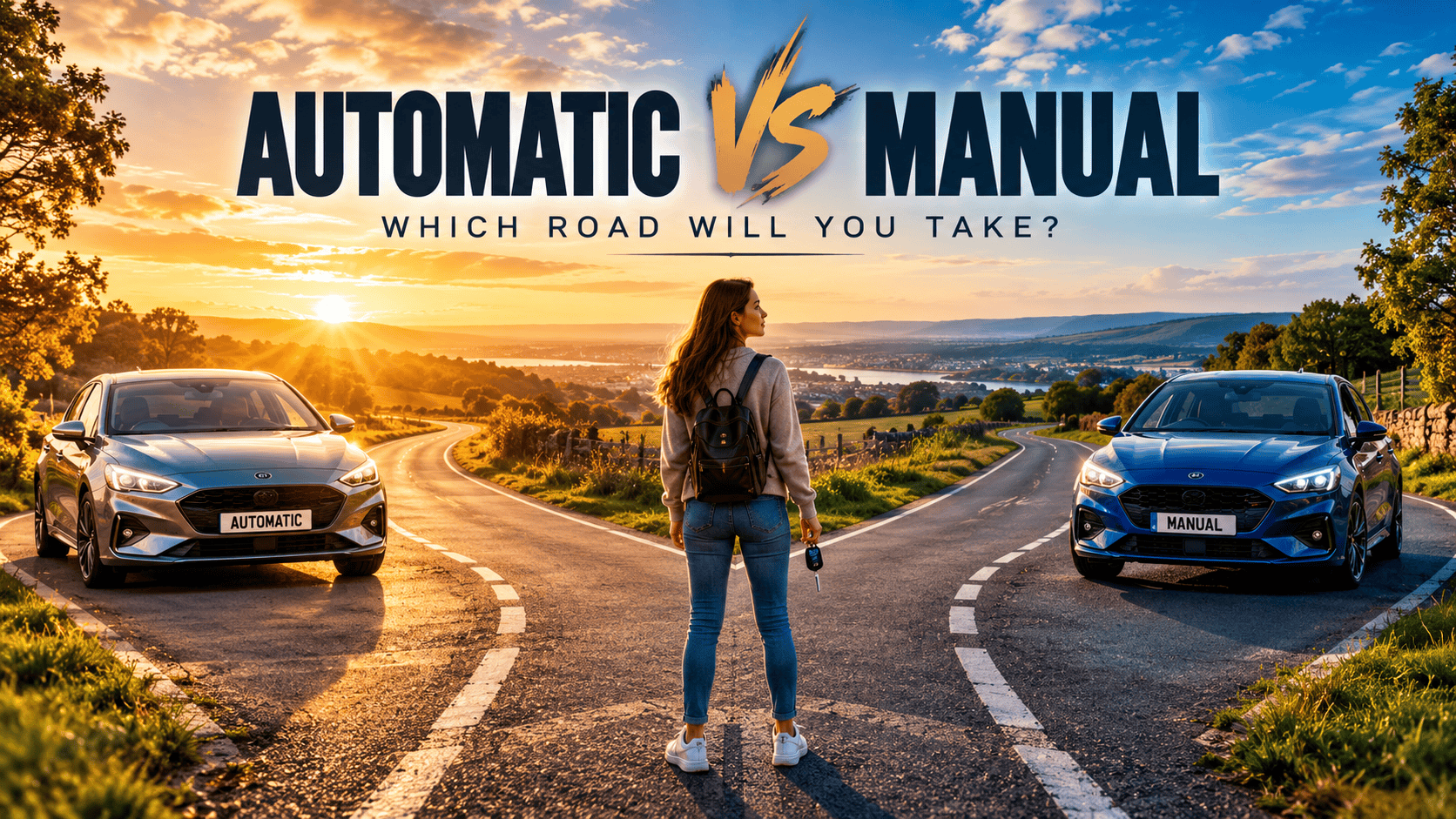
Automatic or Manual Driving Lessons: Which Would Suit You Best?
There's a reason this question doesn't have one perfect answer.
Learners are different.
Some can't wait to master a manual gearbox.
Others would happily never touch a clutch pedal.
Some are working towards a licence because they need to drive for work.
Others simply want the freedom to visit friends, travel independently or stop relying on lifts.
Your priorities should guide your choice.
Automatic Driving Lessons Could Be Right for You If…
You want to make the early stages of learning feel less complicated.
Perhaps you're nervous about stalling.
Maybe you've tried manual lessons and found the clutch difficult.
Or you simply expect to drive automatic vehicles and don't see much value in learning manual gear changes.
Automatic lessons can remove some of the technical demands of driving, giving you more attention for observation, road positioning and traffic awareness.
They may also help you progress more quickly through basic vehicle-control skills.
Just remember that you'll receive automatic-only entitlement when you pass.
Manual Driving Lessons Could Be Right for You If…
You want the freedom to drive either transmission type.
Perhaps you're planning to buy a manual car.
Maybe you'll need to drive different vehicles for work.
Or you simply like knowing that your licence won't restrict you to automatics.
Manual lessons may feel more demanding initially, particularly while you're learning clutch control.
But those extra skills give you broader driving entitlement after passing.
Still Undecided? Find Yourself in This Comparison
| If You're Thinking… | Consider… | Here's Why |
|---|---|---|
| "I want driving to feel less complicated." | Automatic | Fewer controls to coordinate |
| "I'm worried about stalling." | Automatic | No conventional manual clutch stalling |
| "I'd like to learn as efficiently as possible." | Automatic | May reduce time spent learning vehicle controls |
| "I want to drive any type of car." | Manual | Broader licence entitlement |
| "I'm planning to buy an electric car." | Automatic | Similar basic pedal operation |
| "I might need to drive manual for work." | Manual | Manual entitlement may be necessary |
| "I'm watching every pound I spend." | Compare both | Total lesson cost matters more than hourly price alone |
| "I'm not sure what car I'll own later." | Manual may suit you | Keeps more vehicle options open |
If you're still torn between the two, speaking to a qualified driving instructor can help.
A good instructor should be interested in your goals, your confidence and the way you learn, rather than simply pushing you towards one option.
Automatic vs Manual Driving Lessons: Questions Learners Often Ask
I'm completely new to driving. Would automatic be easier for me?
For many beginners, yes.
Automatic cars are generally easier to operate because there's no clutch pedal or manual gear changing. That means fewer controls to think about during your first lessons.
You can spend more attention on steering, observation, road positioning and understanding how traffic behaves.
You'll still need to learn all the essential skills required for safe driving, but automatic can make the initial experience feel more manageable.
If I learn automatic, could I pass my test sooner?
It's possible.
Some learners reach test standard in fewer automatic lessons because they don't need to spend time mastering clutch control and manual gear changes.
However, everyone learns at a different pace.
Your confidence, lesson frequency, previous experience and practical test availability will all influence how quickly you can pass.
Automatic lessons can simplify parts of learning, but they don't guarantee a quicker result.
I'm nervous about driving. Should I avoid manual lessons?
Not necessarily.
Plenty of nervous learners successfully learn manual with patient, supportive instruction.
However, if clutch control and gear changes are making you feel overwhelmed, automatic lessons may be worth considering.
Having fewer controls to coordinate can make early driving experiences feel less demanding.
The most important thing is choosing an approach that helps you develop confidence and safe driving skills.
Are automatic driving lessons always more expensive?
No.
Automatic lessons can cost more per hour, but prices vary between instructors and locations.
Some learners may also need fewer hours in an automatic car, although that isn't guaranteed.
To work out which option offers better value, compare actual hourly rates and realistic estimates of the total tuition you might need.
Is the automatic driving test easier to pass?
An automatic car is generally simpler to operate, which can make the test feel easier for learners who struggle with manual gear changes.
However, the essential driving standards are the same.
You'll still need to demonstrate safe observation, judgement, road positioning, speed control and hazard awareness.
Choosing automatic doesn't guarantee that you'll pass.
What if I pass in an automatic and later want to drive manual?
You can upgrade your licence.
You'll need to learn how to operate a manual car and pass a practical driving test in one.
Once you have the appropriate manual entitlement, you'll generally be able to drive both manual and automatic cars within your licence category.
You may need additional lessons before taking that test.
If I pass in a manual, can I buy an automatic car?
Absolutely.
A full manual car licence generally allows you to drive both manual and automatic cars.
You can learn manual, pass your test and then choose an automatic vehicle without taking another practical test.
That flexibility is one of the main reasons some learners prefer manual lessons.
Is learning manual still worth the effort in 2026?
It can be.
Manual cars remain in use across the UK, and a manual licence gives you more flexibility when choosing vehicles.
However, if you're confident you'll only drive automatic or electric cars, automatic lessons may be more suitable.
The decision comes down to your future driving needs and how much you value broader licence entitlement.
I've already had manual lessons. Is it too late to switch?
Not at all.
You can switch from manual to automatic at any point.
Skills such as steering, observation, road positioning and hazard awareness will still be useful.
You'll simply need to adapt to the automatic car's controls.
If you're considering switching, discuss your progress and concerns with your instructor.
I'm learning later in life. Would automatic lessons suit me better?
They might, particularly if you prefer having fewer vehicle controls to manage.
But age alone doesn't determine which transmission is best.
Your confidence, learning preferences, previous experience and future driving plans are much more useful considerations.
Many adults successfully learn both automatic and manual.
Can I take automatic and manual driving lessons at the same time?
Yes, although alternating between different vehicle controls may be confusing for some beginners.
If you're interested in learning both, speak to an instructor about your goals.
They can help you decide whether combining lessons makes sense or whether concentrating on one transmission initially would be more productive.
Will a manual or automatic first car be cheaper to insure?
There's no guaranteed answer.
Insurance prices depend on the particular vehicle and your circumstances, including your age, location, driving history and annual mileage.
The best approach is to compare insurance quotes for the actual cars you're considering.
Don't assume that one transmission will always be cheaper.
Products / Tools / Resources
Choosing between automatic and manual driving lessons is easier when you have relible information, realistic prices and a clear idea of what learning will involve.
These resources can help you explore your options and prepare for the road ahead.
1. Automatic Driving Lessons — OMG! I'm Driving
If you'd prefer to learn without managing a clutch or changing gears manually, automatic lessons are worth exploring.
They can be particularly appealing to complete beginners, nervous learners and anyone planning to drive an automatic vehicle after passing.
Explore: [Automatic Driving Lessons – internal link]
2. Manual Driving Lessons — OMG! I'm Driving
Want the flexibility to drive both manual and automatic cars?
Manual lessons will help you develop clutch control, gear-changing skills and the essential driving abilities needed for your practical test.
Explore: [Manual Driving Lessons – internal link]
3. Driving Lesson Prices and Packages
Before committing to lessons, compare hourly prices and any available packages.
Remember to consider the total amount you may spend rather than focusing only on the price of a single lesson.
Explore: [Driving Lesson Prices – internal link]
4. Driving Lessons for Nervous Beginners
If you're worried about your first lesson, struggling with confidence or wondering whether automatic might suit you better, practical guidance can help you feel more prepared.
Look for advice on managing first-lesson nerves, building confidence gradually and choosing a supportive instructor.
Read: [Driving Lessons for Nervous Beginners – internal link]
5. Official DVSA Driving Test Information
The Driver and Vehicle Standards Agency provides information about practical driving tests, driving instructors and test standards in Great Britain.
It's a useful source when checking official requirements or understanding what examiners assess.
Resource: DVSA — Official Government Information
6. UK Driving Licence Categories
Not sure what you're legally allowed to drive after passing in an automatic or manual car?
The official GOV.UK guidance explains driving licence categories and entitlements.
Resource: GOV.UK — Driving Licence Categories
7. The Official Highway Code
Whether you're learning automatic or manual, you'll need a solid understanding of road signs, traffic rules, road markings and safe driving behaviour.
The Highway Code is an essential reference throughout your learning journey.
Resource: The Highway Code — GOV.UK
8. Official Driving Theory Test Practice
Preparing for your theory test is an important part of learning to drive.
Official practice materials can help you become familiar with the types of questions you'll encounter and the knowledge you're expected to develop.
Resource: Practice Theory Tests — GOV.UK
9. Driving Lesson Cost Calculator
A simple spreadsheet can help you compare automatic and manual tuition.
Enter the hourly price for each option, estimate the lesson hours you might need and calculate the potential total cost.
Calculation:
Estimated lesson hours × Hourly lesson price = Estimated tuition cost
Keep your estimates realistic, and remember to include other relevant expenses such as test fees.
10. First Driving Lesson Preparation Checklist
Before your first lesson, it helps to know what to expect.
Make sure you have the required provisional driving licence, wear comfortable shoes suitable for controlling the pedals and confirm your lesson arrangements with your instructor.
You can also familiarise yourself with basic road signs and vehicle controls beforehand.
We offer manual and automatic driving lessons in the Burton on Trent and Swadlincote areas.