
Burton Driving Test Routes: What Learners Should Know Before Test Day
A Burton / Swadlincote Driving Guide from OMG! I'm Driving.
Driving lessons with some of the highest pass rates in the area.

Burton Driving Test Routes:
What Learners Should Know Before Test Day
There comes a point before almost every driving test when curiosity gets the better of you.
You know the test centre. You know the date. You may even have started thinking about what you'll wear, how early you'll arrive and whether you'll manage to eat breakfast beforehand.
But one question keeps hanging around:
Where are they actually going to take me?
If your practical test is booked in Burton-on-Trent, searching for Burton driving test routes can feel like the obvious next step. Find the roads. Learn the difficult bits. Remove a few surprises.
There is some sense in that. Familiar roads can make test day feel less daunting.
But there's a catch.
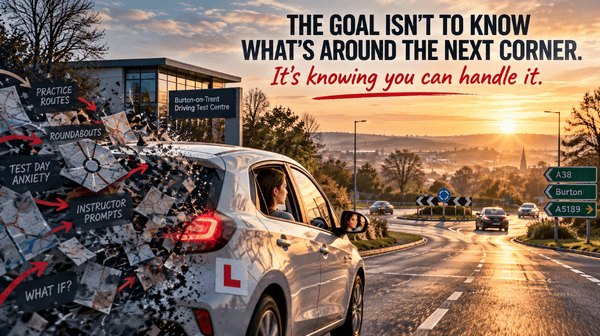
Trying to memorise a Burton driving test route isn't the same as preparing to drive it well.
Your examiner isn't looking for proof that you remember which exit comes after which roundabout. They're assessing whether you can read the road, notice hazards, choose the right position, control your speed and make safe decisions without somebody beside you quietly rescuing the situation.
Current DVSA examiner guidance covers route-based independent driving as part of the practical test, while the assessment itself looks at skills including observation, positioning, judgement, appropriate speed and independent decision-making.
So yes, get to know Burton.
Just don't try to memorise it.
The more useful goal is to become comfortable enough with Burton's roundabouts, junctions, residential roads, faster routes and changing traffic conditions that it doesn't matter quite so much which way the examiner asks you to turn.
Burton Driving Test Routes: The Short Answer
There isn't one fixed Burton driving test route that every learner follows.
Different roads and traffic situations can be used, so a route you've found online shouldn't be treated as a promise of what will happen on your test.
Historic route examples published online have included roads such as the A38, Derby Road, Wellington Road, Horninglow Road, Shobnall Road and roads around Branston. They're useful clues about the kind of driving environments worth experiencing, but they're much less useful as something to memorise turn by turn.
What deserves your attention instead?
Roundabouts. Lane selection. Faster roads. Residential streets. Meeting traffic. Changing speed limits. Busy junctions. Pedestrian crossings. Independent driving. And those awkward moments when the road does something you weren't expecting.
That's the preparation that travels with you whichever route you get.
First, Get Your Bearings Around Burton Driving Test Centre
Burton-on-Trent Driving Test Centre is at Wellington Park, Burton-on-Trent, DE14 2TG.
The surrounding road network gives you a useful hint about why varied practice matters. Nearby you'll find Wellington Road and the A5121, with access to the A38 not far away.
In a relatively short drive, the character of the road can change considerably.
One moment you're dealing with an ordinary urban street. A little later, there may be heavier traffic, different lane choices, a roundabout or a faster stretch of road demanding a completely different level of planning.
That's why practising only the streets immediately outside the test centre can create false confidence.
You don't simply want to know how to leave Wellington Park.
You want to feel comfortable with what might happen after you leave it.
Should You Actually Learn Burton Driving Test Routes?
Practise them? Absolutely.
Memorise them? That's where things become less useful.
Imagine you've practised the same roundabout six times. You know you're normally taking the second exit. You know the lane your instructor usually asks you to use. You even recognise the building where you start slowing down.
It feels reassuring.
Then test day arrives and you're asked to take a different exit.
Suddenly, the thing you learned wasn't really the roundabout. It was a routine.
The skill lies underneath that routine.
Can you read the sign early enough?
Can you understand the road markings?
Can you select an appropriate lane without somebody prompting you?
Can you control the approach, observe properly, judge the traffic and move when it's safe?
That's what survives when the destination changes.
The same is true of speed limits. Knowing from memory that a particular road changes speed doesn't prove much. Noticing the sign yourself and adjusting appropriately does.
So there is one question worth carrying into every practice drive:
What skill is this road asking me to use?
Once you start thinking that way, Burton stops being a collection of possible test routes and becomes something far more useful: a training ground.
Roads Around Burton Worth Experiencing Before Test Day
Nobody can responsibly promise that a particular road will appear on your test.
What you can do is expose yourself to enough different driving environments that very little feels completely new.
Several roads around Burton are particularly useful for that.
The A38: Where Everything Starts Happening Faster
The A38 is close to the Burton test-centre area, and historic third-party route examples have included sections of it.
That doesn't mean you'll necessarily drive on the A38 during your test.
It does mean that becoming comfortable with faster-road driving is sensible preparation.
At higher speeds, your world changes.
Signs arrive sooner. Gaps disappear faster. A vehicle slowing ahead matters earlier than it would on a quiet residential street.
This is where forward planning becomes visible.
Look beyond the bumper in front of you. Read signs while you still have time to respond. Keep a sensible following distance and maintain appropriate lane discipline.
If you're joining or leaving a faster road, avoid treating it as a dramatic event. Observe. Build your understanding of the traffic. Make a controlled decision.
And keep watching your speed.
The posted limit is a maximum, not an instruction to reach that speed regardless of traffic, weather or visibility. Equally, driving significantly below an appropriate speed simply because you're nervous can create problems of its own.
DVSA assessment guidance considers both positioning and lane discipline, as well as whether you're making appropriate progress for the conditions.
The examiner isn't looking for bravery.
They're looking for judgement.
Wellington Road and the A5121: Give Yourself Time to Think
The A5121 runs close to Burton Driving Test Centre, with Wellington Road forming part of the immediate local road environment.
Roads like this reward drivers who look beyond what is directly in front of the bonnet.
Start scanning further ahead.
Where are the lights?
Is there a crossing coming up?
What do the lane markings say?
Is traffic beginning to queue?
Is there a sign telling you something you'll need to act on in another ten seconds?
Good planning often looks uneventful from the passenger seat. That's the point.
You've noticed the problem before it became a problem.
And if you know you're going to need another lane, prepare early enough to make the change calmly. A mirror check and controlled move made in good time is far better than discovering the arrows underneath your wheels and suddenly trying to fix everything.
A5189 and Burton's Busier Urban Roads
Parts of the A5189, including Evershed Way, Anglesey Road and Shobnall Road, sit within Burton's wider road network.
Urban driving asks your brain to juggle quite a lot.
A pedestrian is approaching a crossing. There's a cyclist ahead. A parked van is obscuring part of a junction. The lights have changed. Somebody behind looks impatient.
None of those things individually needs to be difficult.
It's the combination that raises the workload.
The temptation is to react faster.
Usually, the better answer is to look earlier.
Early observation buys time. Time gives you options. Options make calm decisions possible.
That's a habit worth building long before test day.
Burton Roundabouts: Stop Trying to Predict Them
Roundabouts occupy a strange amount of space in a learner driver's head.
Often, it isn't the actual act of going around one that's frightening.
It's everything happening in the five or ten seconds beforehand.
Which exit did they say?
Which lane do I need?
Is that car coming around?
Can I go now?
Should I be signalling already?
When those questions arrive all at once, even a familiar roundabout can suddenly look complicated.
The answer isn't to memorise more roundabouts. It's to build a process you trust.
Read before you arrive
Direction signs and road markings are there to help you.
Use them early.
If you leave all your thinking until the give-way line is almost underneath the car, you've turned an ordinary decision into a rushed one.
Choose your position calmly
Work out where you need to be from the information available.
If a lane change is necessary, check your mirrors and make it safely.
Don't dart across because you've suddenly spotted an arrow.
Give yourself time on the approach
Speed changes how much thinking time you have.
A controlled approach lets you observe properly rather than desperately searching for a gap.
Look again
The vehicle ahead has moved.
That doesn't mean you can.
A safe opportunity belongs to the driver who has actually observed it, not the driver who happened to be following someone else.
Leave without switching off
The roundabout isn't finished the moment you've passed your exit sign.
Keep observing, signal appropriately and position the car safely as you leave.
The aim isn't to become brilliant at one Burton roundabout.
It's to develop a routine that still works when you've never seen the roundabout before.
That's real independence.
“But What If I Get Into the Wrong Lane?”
This is one of those questions learners often whisper as though the answer might be catastrophic.
It isn't.
Suppose the sat nav wants you to take a particular exit. You've misunderstood the markings and you're now sitting in a lane that doesn't comfortably take you there.
Your brain may immediately shout:
Fix it.
That's where a small navigation mistake can become a genuine driving problem.
Don't force a late lane change simply because you're worried about going the wrong way.
Drive safely from the position you're in.
Official examiner guidance allows for candidates to be redirected when they go off the intended route during independent driving. A sat nav can also recalculate.
The destination matters less than your decision-making.
Put another way:
Taking the wrong road isn't automatically a driving fault. Making an unsafe move because you're frightened of taking the wrong road can be.
Remember that.
It can save you from turning a perfectly manageable moment into something much bigger.
Quiet Residential Streets Aren't Always the Easy Part
Faster roads and big roundabouts get most of the pre-test attention.
Then a narrow residential road appears and quietly asks you to make six judgement calls in thirty seconds.
Cars are parked on both sides. A pedestrian is walking near the kerb. An oncoming vehicle appears ahead. Someone opens a car door.
Suddenly, 20 or 30 mph doesn't feel particularly simple.
Meeting traffic means thinking ahead
Don't wait until you're bonnet-to-bonnet with another vehicle before deciding who has space to go through.
Look further ahead.
Where does the road narrow?
Where are the gaps?
Where could you safely wait?
Sometimes the best decision is to hold back several car lengths earlier because you can already see what is developing.
Parked vehicles deserve space - and attention
Give parked vehicles appropriate clearance where possible.
But don't see them merely as stationary obstacles.
A driver may be inside. Brake lights might appear. Wheels may begin to turn. A door might open.
Tiny clues matter.
At restricted junctions, don't guess
Sometimes you simply can't see enough.
That's not an invitation to hope.
Use careful observations and appropriate vehicle control to improve your view before committing.
You aren't being assessed on how quickly you escape the junction.
You're being assessed on whether you gathered enough information to make a safe decision.
Speed Limits Around Burton Can Change the Feel of a Drive Quickly
The road network surrounding Burton Driving Test Centre moves between very different environments, including urban roads and faster routes.
That makes one skill especially valuable: noticing when the road has changed character before your driving becomes inappropriate for it.
Speed signs matter, obviously.
But so does context.
Learners sometimes become so focused on a direction from the sat nav that a speed-limit sign barely registers.
Others see the new limit perfectly well but remain far below an appropriate speed because they're nervous about making a mistake.
Safe driving sits between those extremes.
DVSA guidance expects candidates to use a speed appropriate to the road and traffic conditions while avoiding unnecessary delay to other road users. Both inappropriate speed and undue hesitation can cause problems.
So instead of asking yourself only:
“What's the speed limit?”
Add another question:
“What speed makes sense for what is happening in front of me?”
That's the judgement you're trying to develop.
Independent Driving: The Bit That Sounds Scarier Than It Is
Here is something worth knowing if you've been trying to learn every possible Burton driving test route:
You are not expected to know Burton by heart.
During the independent-driving part of the practical test, you may follow a sat nav, traffic signs or a combination of both. Current DVSA examiner guidance provides for at least 20 minutes of independent driving, with the section capable of running longer.
When a sat nav is used for the test, the examiner manages it.
You still have one job.
Drive the car safely.
And if I miss the turning?
Keep driving.
Seriously.
Don't snatch at the steering wheel. Don't make an abrupt lane change. Don't let embarrassment convince you that something terrible has happened.
The examiner can redirect you. The sat nav can recalculate.
This is exactly why independent driving matters.
After you've passed, nobody will sit beside you saying, “Mirrors… now move over.”
You'll miss turns. You'll encounter diversions. You'll arrive at junctions you've never seen.
The skill isn't knowing every road.
It's being able to deal with the road you have.
What Is the Examiner Actually Looking For?
This is where obsessing over routes can become a distraction.
The examiner is assessing your driving.
DVSA test-result guidance covers areas including:
- observations at junctions
- use of mirrors
- positioning and lane discipline
- appropriate speed and progress
- signals
- response to traffic signs and road markings
- vehicle control
- awareness and planning
- moving off safely
- observations during manoeuvres and reversing
The current pass standard permits up to 15 driving faults, provided you don't make a serious or dangerous fault. Repeated problems can also become significant depending on their nature and circumstances.
Think about what that means in practice.
Someone could memorise every supposed Burton driving test route they can find and still struggle because their observations at junctions aren't reliable.
Another learner could be taken down a road they've never driven before and handle it perfectly well because their underlying skills are solid.
Which driver is genuinely closer to being ready to drive alone?
That's the question that matters.
The Little Mistakes That Can Snowball
Driving tests have a peculiar psychological effect.
Something tiny happens and suddenly it feels enormous.
You select the wrong lane.
Your heart jumps.
You think you've failed.
Your concentration moves away from the road and into your own head.
Then the next mistake happens.
This is why preparation isn't only about knowing what to do. It's also about learning how to reset.
Don't leave lane choices until the last second
Read signs and markings early.
Give yourself room to think.
Don't let the sat nav steal your attention
It's giving you directions, not driving the car.
Listen to it. Glance when necessary. Keep your attention where the hazards are.
Don't sleepwalk through speed changes
Keep scanning.
Roads change character quickly, and your driving needs to change with them.
Don't confuse hesitation with safety
Waiting is correct when it isn't safe to proceed.
Waiting simply because you don't trust your judgement is something different.
Learn to recognise a safe opportunity and use it.
Don't try to rescue every mistake
Missed the turn?
Fine.
Wrong lane?
Deal with it safely.
A small error doesn't need an emergency response.
Don't let busy situations destroy your observations
The more complicated the situation becomes, the more tempting it is to stare at the single thing worrying you.
Keep your awareness broad.
National DVSA data on reasons for failing reinforces the importance of fundamentals such as junction observations, mirrors, positioning, traffic signs, road markings and appropriate speed.
None of those depend on memorising a route.
How to Practise Burton Driving Test Routes Without Wasting Your Lessons
A good lesson before your test shouldn't feel like sightseeing.
You're not collecting roads.
You're building responses.
Stop repeating the same circuit
Ask your instructor to vary things.
If you know every turn before the indicator goes on, you're removing the very uncertainty you need to learn to handle.
Experience Burton at different times
The same road can feel completely different depending on traffic.
A quiet mid-morning junction may require another level of patience and planning when it's busy.
Variety makes you respond to reality rather than memory.
Ask your instructor to become quieter
This can feel uncomfortable at first.
That's useful.
As your test approaches, you should increasingly be spotting hazards, choosing lanes, reading signs and making decisions without prompts.
Silence exposes the gaps.
And once you can fill those gaps yourself, confidence begins to feel very different.
Drive somewhere you don't know
There is enormous value in reaching a junction and genuinely not knowing what's coming next.
Now you have to read it.
That's what independent driving really is.
Take a proper mock driving test
A realistic mock test can uncover habits that ordinary lessons sometimes disguise.
DVSA provides guidance to instructors on conducting mock tests using realistic test conditions and the practical-test assessment standard.
The purpose isn't to give you a frightening rehearsal.
It's to find the weak spot while there's still time to work on it.
Are You Actually Ready? Try This Without Your Instructor Helping
Forget your test date for a moment.
Forget how many lessons you've had.
Forget whether your friend passed after fewer hours.
Ask yourself something more useful.
Can you reach an unfamiliar roundabout and work out the correct position without help?
Can you notice a change of speed limit while you're also following directions?
Can you drive confidently on a faster road without becoming hesitant or losing your lane discipline?
Can you judge when to wait behind parked cars and when there's enough room to continue?
Can you follow a sat nav without staring at the screen?
Can you miss a turning and remain calm?
Can you reach a junction, observe properly and decide for yourself when it's safe to proceed?
And perhaps most importantly:
Can you make a small mistake without mentally leaving the test?
That final skill is underrated.
You don't need a magically perfect drive.
Official test guidance makes clear that a mistake does not necessarily mean you've failed. What matters is what the mistake was, how serious it became and what happened afterwards.
If something feels imperfect, keep driving.
The road in front of you still needs your attention.
Your Final Week Before a Burton Driving Test
The last week has a strange way of making learners want to do everything at once.
Every roundabout suddenly seems important. Every road somebody mentions becomes something you apparently must practise.
Resist the urge to cram Burton into your head.
Use the time more deliberately.
About a week before: find the real weaknesses
Be brutally specific.
“I'm bad at roundabouts” isn't especially useful.
“I hesitate too long when judging gaps on busy roundabouts” is.
“I struggle with driving fast” is vague.
“I stop scanning far enough ahead when I move onto faster roads” gives you something to practise.
Specific problems can be fixed.
A few days before: make practice uncomfortable enough to be useful
Try different roads.
Reduce instructor prompts.
Practise the situations you're still tempted to avoid.
This isn't the moment to spend an hour doing only the things you're already good at because it feels reassuring.
Around two days before: try a realistic mock
Let it run like a test.
No coaching through the difficult bits. No helpful reminders just before a junction.
See what happens.
Then use what happened.
The day before: leave the route maps alone
You aren't going to transform your driving by memorising another twelve road names at 10pm.
Get yourself organised instead.
Check what you need to take. Know where you're going. Give yourself the best chance of arriving rested rather than mentally exhausted from trying to predict the unpredictable.
On test day: drive what's actually there
Not the route you practised yesterday.
Not the mistake you're frightened of making.
Not the result you're hoping to hear at the end.
The road that's actually there.
That's enough.
Burton Driving Test Routes: The Questions Learners Really Ask
“Are Burton driving test routes basically the same every time?”
No. Don't assume your test will follow a route because another learner drove it or because you've found it online.
Historic route information can help you identify useful areas and road types to practise, but your preparation needs to work when the examiner takes you somewhere unexpected.
“Can I just learn all the Burton test routes?”
You can familiarise yourself with local roads, but trying to memorise every possible turn is unlikely to be the best use of your preparation time.
Learn the area, certainly.
More importantly, learn how to handle unfamiliar roads safely.
That's the ability you'll need once you've passed anyway.
“Could they take me onto the A38?”
Historic third-party route examples have included the A38, and it lies close to the Burton test-centre area.
That doesn't guarantee you'll use it during your test.
If faster-road driving still makes you uncomfortable, though, that's a good reason to practise the skill rather than gamble on whether a particular road appears.
“Which Burton roads should I practise?”
Useful practice environments include roads around Wellington Park, the A5121, parts of the A5189 and appropriate experience of faster roads such as the A38.
Don't stop there.
Include residential streets, roundabouts, busy junctions, pedestrian crossings, traffic lights and roads where the speed limit or traffic environment changes.
Variety is the point.
“What if I go the wrong way during my driving test?”
Keep driving safely.
During independent driving, the examiner can redirect you and a sat nav can recalculate.
Don't turn a navigation error into a driving error by making a rushed or unsafe correction.
“Will I definitely have to follow a sat nav?”
The independent-driving section can involve following a sat nav, traffic signs or a combination of both.
When the test uses a sat nav, the examiner manages the device.
You don't need to know the destination.
You need to drive safely while following the directions you're given.
“How many driving faults can I get and still pass?”
The current standard allows 15 or fewer driving faults, provided there are no serious or dangerous faults.
That doesn't make 15 a target.
The useful goal is consistent, safe driving rather than mentally counting every tiny thing you think might have gone wrong.
“Should I have lessons around Burton before my test?”
If Burton is unfamiliar, or there are local driving environments you're not yet comfortable handling, lessons in the area can be valuable.
Use them to strengthen the skills behind the roads rather than merely rehearsing a route.
A productive local lesson should leave you better equipped to deal with a road you haven't practised—not just better at remembering one you have.
We offer manual and automatic driving lessons in the Burton on Trent and Swadlincote areas.