
Can You Beat the Burton Driving Test Pass Rate? A Data-Led Test Preparation Plan
A Burton / Swadlincote Driving Guide from OMG! I'm Driving.
Driving lessons with some of the highest pass rates in the area.

Can You Beat the Burton Driving Test Pass Rate?
A Data-Led Test Preparation Plan
There is something strangely compelling about a pass-rate percentage.
You have a driving test coming up in Burton, you know you should probably be thinking about observations, roundabouts and whether your manoeuvres are genuinely test-ready... and yet there you are, searching for the Burton driving test pass rate.
It makes sense.
A number feels solid. Reassuring, even. It gives you something concrete to hold onto when the test itself still contains so many unknowns.
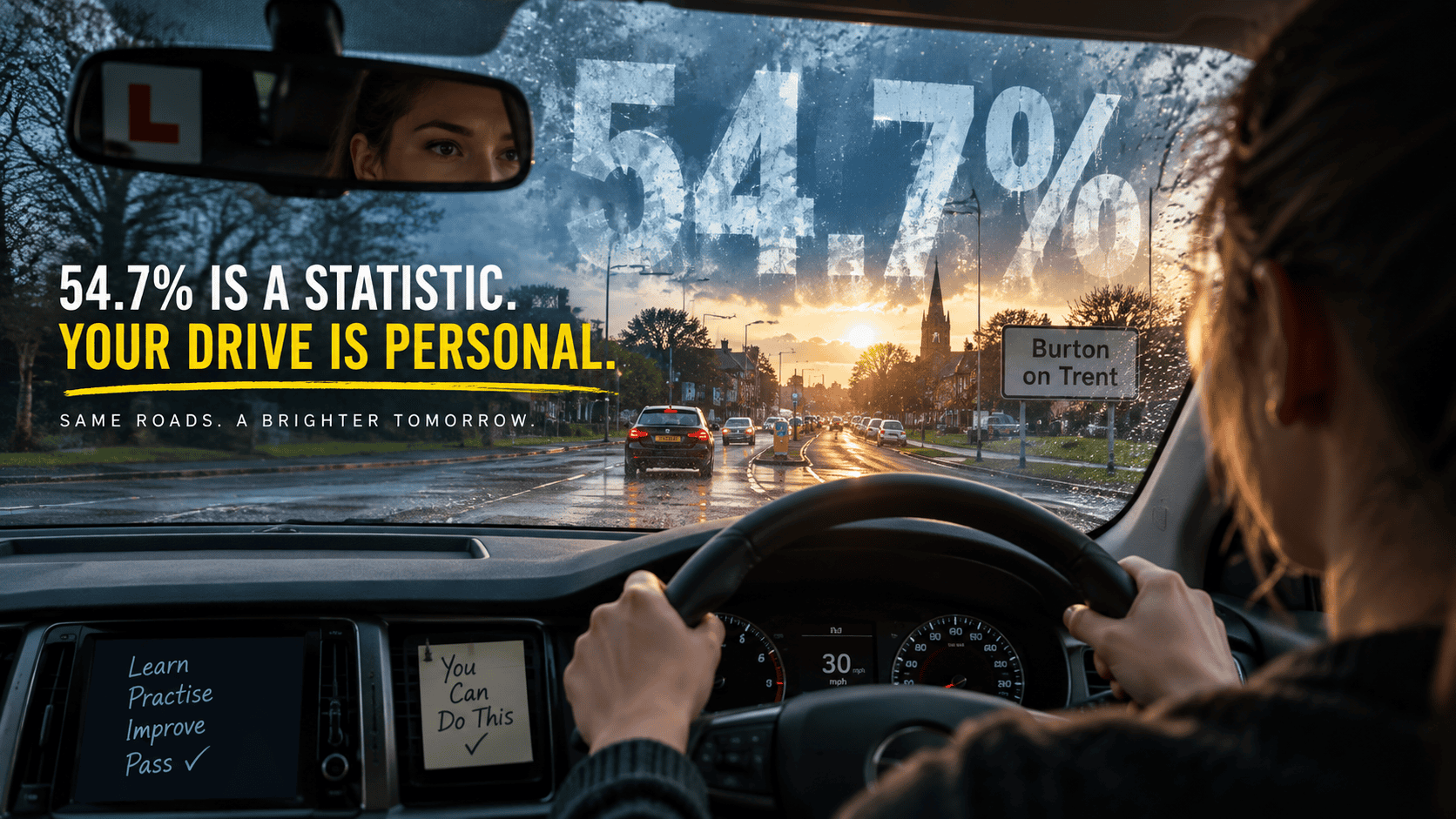
The latest published DVSA figures cover April 2025 to March 2026. During that period, 7,273 car driving tests were conducted at Burton on Trent, with 3,981 passes. That gives Burton an overall driving test pass rate of 54.7%.
At first glance, you might read that as: I've got about a 55% chance of passing.
Except that isn't really what the statistic means.
The Burton driving test pass rate tells us what happened across thousands of previous tests. It cannot tell us what will happen when you sit behind the wheel.
And that's an important distinction.
Because you can't do anything about Burton's historic pass rate.
You can do quite a lot about your preparation.
The Burton Driving Test Pass Rate at a Glance
Before getting into preparation, here's the data you're probably looking for.
| Burton driving test statistic | Latest published figure |
|---|---|
| Overall pass rate | 54.7% |
| Tests conducted | 7,273 |
| Tests passed | 3,981 |
| First-attempt pass rate | 56.5% |
| Period | April 2025–March 2026 |
The overall figures come from DVSA's published driving-test statistics, which include test-centre-level data.
There's another number worth noticing.
Burton's first-attempt driving test pass rate was 56.5% during 2025/26.
Interesting? Absolutely.
A prediction of what will happen on your first attempt? No.
That's where pass-rate statistics are easy to misunderstand. They describe a group of learners. Your test is an individual assessment of your driving.
Once you see the difference, a more useful question emerges.
Instead of asking, “What percentage of people pass at Burton?”, start asking:
“What would make me genuinely ready to pass at Burton?”
That question can actually change something.
Burton's Pass Rate Has Been Rising — But Don't Read Too Much Into It
Look back over the recent figures and Burton's pass rate has followed an upward path.
| Financial year | Tests | Passes | Pass rate |
|---|---|---|---|
| 2021/22 | 6,099 | 2,939 | 48.2% |
| 2022/23 | 5,253 | 2,718 | 51.7% |
| 2023/24 | 7,177 | 3,770 | 52.5% |
| 2024/25 | 6,682 | 3,615 | 54.1% |
| 2025/26 | 7,273 | 3,981 | 54.7% |
That's an increase of around 6.5 percentage points between 2021/22 and 2025/26.
It is tempting to attach a story to that.
Maybe Burton is getting easier. Maybe the roads are friendlier. Maybe examiners are more forgiving.
Those conclusions don't follow from the numbers alone.
Pass rates can shift for all sorts of reasons, including differences in the candidates taking tests during a particular period. The practical driving test still comes down to the standard demonstrated by the person driving the car.
So use the Burton driving test pass rate for context.
Don't let it become a horoscope.
1. Forget About Beating 54.7% for a Moment
Driving-test statistics can quietly mess with your head.
Once you've seen that 54.7% figure, it's very easy to imagine two invisible queues forming outside Burton test centre.
One for people who pass.
One for people who don't.
You start wondering which queue you're destined for.
But you're not drawing a number out of a hat. Your test is an assessment.
Under DVSA rules, you can pass with no more than 15 driving faults, provided you don't make a serious or dangerous fault.
That's a much more useful place to begin.
Rather than wondering:
“What are my chances?”
ask yourself:
“Can I drive safely and consistently without my instructor rescuing the situation?”
That's a harder question.
It's also a much better one.
What Test-Ready Driving Actually Feels Like
Being test-ready isn't the same as having one brilliant lesson.
Most learners have those.
Everything clicks. The gears behave. Every roundabout seems to open at exactly the right moment. Your instructor barely says a word and you get out of the car feeling ten feet tall.
Then the next lesson arrives.
Suddenly you're overthinking a junction you've driven through twenty times.
The difference between a good lesson and genuine test readiness is consistency.
You should increasingly be able to drive independently without constant prompts, notice hazards early, judge junctions safely, choose an appropriate speed and make effective observations before changing position or direction.
And when something doesn't go quite to plan?
You deal with it.
You don't mentally collapse because the drive stopped being perfect.
That ability to handle the unexpected is one of the clearest signs that you're moving from learner following instructions to driver making decisions.
2. Your Most Useful Mistakes Are the Ones That Keep Coming Back
Nobody learns to drive without making mistakes.
You stall.
You miss a mirror check.
You hesitate when you could have gone.
You approach something too quickly and suddenly find yourself trying to process five things at once.
That's learning.
What matters more is whether the same weakness keeps returning.
Imagine you've had four lessons and your instructor has mentioned your approach speed at roundabouts in three of them.
That's no longer random.
It's a pattern.
And patterns are where your preparation should become much more focused.
Keep a Simple Driving Fault Log
You don't need an elaborate spreadsheet.
After a lesson, write down three things.
What happened?
Be precise. “Roundabouts were terrible” tells you almost nothing.
“I approached too quickly, which left me less time to assess traffic from the right” gives you something you can actually work with.
Then ask:
Why did it happen?
Were you looking too late? Carrying too much speed? Focusing on gears instead of traffic? Feeling pressured by the vehicle behind you?
Finally:
What do I need to practise next?
Now your next lesson has a purpose.
This sounds simple, but it changes the way you learn. Instead of endlessly accumulating driving hours, you start using those hours to solve specific problems.
One lesson reveals a weakness.
The next targets it.
Then you test whether the improvement holds when the road gets busier.
That's progress you can actually see.
3. Learn Burton's Roads Without Becoming Dependent on Them
It's probably one of the most irresistible searches before a practical test:
Burton driving test routes.
You want to know where you'll go.
Which roundabout.
Which junction.
Which road.
Maybe, if you could somehow practise every possible route enough times, there would be no surprises left.
The problem is that passing your test is supposed to demonstrate something much bigger than your ability to remember familiar roads.
You need to be able to drive somewhere you haven't memorised.
That's what you'll be doing after you pass.
Get Comfortable With Different Roundabouts
Roundabouts can feel deceptively simple when you know them.
Then you meet an unfamiliar layout and suddenly you're reading signs, checking lanes, assessing traffic, controlling speed and trying to work out where your exit actually is.
That's why useful practice isn't just repetition of one familiar roundabout.
It's learning a process you can carry from one roundabout to another.
Observe early.
Read the road.
Position appropriately.
Control your speed.
Make a safe decision.
The scenery changes. The process remains.
Treat Junctions as Decisions, Not Routines
You can rehearse mirror-signal-position-speed-look until the words practically live in your head.
But the road doesn't care whether you remember an acronym.
What matters is whether you've actually understood what is happening.
Can you see enough?
Is anything approaching?
How quickly?
Is there a pedestrian nearby?
Do you have time to emerge safely?
Good junction work should eventually feel less like performing a routine for an instructor and more like gathering information before making a decision.
Don't Underestimate Residential Roads
Quiet-looking streets can ask a surprising amount from you.
Parked cars narrow the available space. A pedestrian can appear between vehicles. Someone opens a car door. An oncoming driver commits to a gap before you've decided whether there's room for both of you.
None of it looks dramatic.
All of it requires judgement.
Practising these situations around Burton can help you develop the habit of looking ahead rather than simply reacting when a problem reaches the bonnet.
Speed Is About Judgement, Not Just the Number on the Sign
One of the most important shifts in learning to drive is realising that the speed limit is a limit, not an instruction to reach that speed regardless of conditions.
The appropriate speed depends on what is happening around you.
Road conditions.
Traffic.
Visibility.
Pedestrians.
Signs.
Hazards.
But there's another side to this.
Driving unnecessarily slowly can create problems too. DVSA assessment guidance includes both inappropriate speed and undue hesitation.
The goal isn't “slow”.
It isn't “fast”.
It's appropriate.
And that ability to adjust naturally to what the road is asking of you is one of the strongest signs of developing driving judgement.
4. A Mock Test Can Reveal Things an Ordinary Lesson Hides
You know your instructor.
You know their voice.
You know the little pause before they're about to remind you of something.
Even without realising it, you can start relying on those cues.
Then test day arrives and the dynamic changes.
The examiner isn't there to coach you through the drive.
That silence can feel enormous.
A well-run mock driving test lets you experience some of that change before the real thing.
Don't Obsess Over Whether You “Passed” the Mock
The least interesting thing about a mock test may actually be the pretend result.
What matters is what the mock exposes.
Did your observations change once the instructor stopped prompting you?
Did you begin hesitating?
Did your speed creep upwards?
Did one small error distract you for the next five minutes?
Did you cope with unfamiliar directions?
Could you make decisions without looking for reassurance from the passenger seat?
Those answers are useful.
A mock test isn't a crystal ball. It's a diagnostic tool.
It shows you what your driving looks like when some of the training wheels — psychologically speaking — disappear.
And sometimes what it reveals isn't technical at all.
Sometimes the real weakness is what happens after you make a mistake.
5. The Mistake That Bothers You Might Not Be the One That Matters
You're ten minutes into the test.
Something feels wrong.
Maybe the gear change was messy. Perhaps you hesitated longer than you'd have liked at a junction. Maybe you realise you could have handled a situation more smoothly.
Then comes the thought.
I've failed.
It arrives fast.
Now you're replaying the last thirty seconds instead of properly concentrating on the next thirty.
Your shoulders tighten. Your breathing changes. You start driving differently because you're no longer responding to the road; you're responding to the story you've invented about your result.
That's dangerous territory.
One Imperfect Moment Doesn't Automatically End the Test
You can pass the practical driving test with up to 15 driving faults, provided you don't make a serious or dangerous fault.
So if something feels imperfect, resist the urge to become your own examiner.
You don't know exactly how the situation was assessed.
And you certainly can't change what happened twenty seconds ago.
There is only one useful place for your attention:
the road in front of you.
A simple mental sequence can help:
Notice. Reset. Continue.
Notice what happened.
Reset your attention.
Continue driving safely.
It sounds almost too simple.
But being able to recover from a mistake without allowing it to trigger another one is useful far beyond test day. You'll need exactly the same skill when you're driving alone.
6. Make Test Day Feel Familiar Before It Arrives
A surprising amount of driving-test anxiety comes from uncertainty.
Where do I go?
What happens first?
When will they ask the questions?
How long will I be driving?
Will the examiner talk to me?
What if I don't understand a direction?
The more mystery you remove beforehand, the less mental energy those questions can consume on the day.
A standard car driving test includes an eyesight check, vehicle-safety questions, general driving ability and independent driving. The driving part lasts around 35 minutes.
Deal With the Eyesight Check Now, Not in the Test-Centre Car Park
You'll be asked to read a vehicle registration plate before the driving part of the test.
If you need glasses or contact lenses to meet the required eyesight standard, you must wear them whenever you drive.
This is one of those wonderfully boring things worth sorting out early.
You have enough to think about on test day without suddenly wondering whether you can read the number plate.
Make “Show Me, Tell Me” Boring
Boring is good here.
You don't want to be sitting in the car thinking, Where on earth is that control?
You'll be asked two vehicle-safety questions: a “tell me” question before driving and a “show me” question while you're on the road.
Practise them in the vehicle you expect to use for your test wherever possible.
Know the controls.
Know where they are.
Then move on.
The aim isn't to turn vehicle-safety questions into a huge revision project. It's to make them so familiar that they take up almost no mental space.
Remember What the Examiner Is Actually Looking For
You're not expected to drive like somebody who has been commuting for twenty years.
You are there to demonstrate that you can drive to the required standard safely and independently.
That distinction matters.
Chasing perfection often makes learners tighter, more hesitant and more afraid of making decisions.
Safe driving requires judgement.
Sometimes that means waiting.
Sometimes it means going.
Sometimes it means recognising that something wasn't perfect and carrying on safely anyway.
7. Having a Test Date Doesn't Automatically Mean You're Ready
Getting a practical test booked can feel like an achievement in itself.
Once the date appears in your calendar, it becomes strangely powerful.
Everything starts orbiting around it.
I have to be ready by then.
But the calendar doesn't know how you're driving.
A booking isn't proof of readiness.
The Better Question Is: What Happens When the Drive Stops Going to Plan?
Anyone can feel confident when the road is quiet and everything unfolds exactly as expected.
Look instead at what happens when conditions change.
What if traffic is heavier than usual?
What if another driver does something unpredictable?
What if you stall?
What if you're taken towards a junction you don't recognise?
What if it rains?
What if you misunderstand a direction?
What if the first ten minutes don't feel particularly good?
Can you still drive safely?
Can you think?
Can you reset?
Can you continue without needing your instructor to take over the decision-making?
That's the sort of consistency worth looking for before test day.
Your Burton Driving Test Preparation Plan
Once you stop treating the Burton driving test pass rate as a prediction, it becomes much easier to focus on the things you can influence.
Work backwards from your test date.
Not with panic.
With purpose.
Four or More Weeks Before: Make Your Driving More Consistent
This is the time to widen your experience.
Different roads. Different traffic levels. Different situations.
Ask your instructor where you're still relying on help.
If there's something you secretly hope won't appear on your test, that's probably something worth practising.
Don't build your preparation around avoiding weaknesses.
Bring them into the open.
Two to Three Weeks Before: Hunt the Patterns
Look back through your lessons.
What keeps returning?
Observations?
Roundabout positioning?
Junction judgement?
Speed?
Meeting traffic?
Moving off safely?
Manoeuvre observations?
Independent decision-making?
Choose the recurring problems and work on them deliberately.
The objective isn't to get something right once.
You want the correct behaviour to survive distraction, nerves and changing road conditions.
That's a much higher standard.
It's also much closer to real driving.
About a Week Before: Put Everything Under Pressure
This is a useful time for a realistic mock driving test.
Treat it as information gathering rather than fortune telling.
If it goes brilliantly, good.
Find out why.
If it goes badly, also useful.
Find out why.
Either way, you come away knowing more about your driving than you knew beforehand.
The Day Before: Don't Try to Become a Different Driver Overnight
You've spent weeks or months learning.
One frantic evening isn't going to transform your driving.
Confirm your arrangements. Make sure you have what you need. Check your glasses or contact lenses if you use them. Run through the vehicle-safety questions.
Then give your brain some room.
Test day isn't an exam where you can cram another chapter at midnight.
You're preparing to demonstrate skills that should already be there.
On Test Day, Shrink Your World
This is where that 54.7% statistic needs to disappear.
You don't need to think about Burton's pass rate.
You don't need to think about your friend's test.
Or the person on TikTok who claimed a particular roundabout was impossible.
Or whether your instructor thinks you're going to pass.
Your world can become much smaller.
The road.
The mirrors.
The hazard developing ahead.
The decision you need to make now.
Then the next one.
That's enough.
Failed at Burton Before? Your Previous Test Contains Useful Information
Failing a driving test can sting.
There's the disappointment itself, obviously. Then there's everything attached to it: the lessons, the money, the anticipation, perhaps friends and family asking how it went.
It can feel much bigger than a driving assessment.
Once that first frustration settles, however, your result gives you something useful.
Evidence.
Look at the faults recorded and resist vague explanations.
“I was just nervous” might be true, but it doesn't tell you what to practise.
Ask where those nerves actually appeared in your driving.
Did you rush?
Did you become hesitant?
Did your observations deteriorate?
Did you focus too heavily on one task and stop looking far enough ahead?
Did one mistake distract you?
Specific problems can be trained.
Vague ones can't.
Your previous attempt doesn't need to become baggage you carry into the next test. Used properly, it becomes a map of where your preparation needs to go next.
Can Driving Lessons in Burton Give You an Advantage?
Local experience can absolutely be useful.
You become familiar with the area's road environments, traffic patterns, junction types and the decisions those situations demand.
But there is a line worth protecting.
Local familiarity should build adaptable driving skills, not dependence on memorised routes.
You don't want to become brilliant at one particular sequence of roads.
You want to become the learner who can turn onto a road they've never seen before and think:
Right. What is happening here?
Then deal with it.
At OMG! I'm Driving, Burton driving lessons can be shaped around your current ability rather than forcing every learner through exactly the same preparation.
Maybe your basic control is strong but busy roundabouts make you tense.
Maybe you're comfortable around Burton but become hesitant when driving independently.
Perhaps you've already taken a test and know precisely which areas need work.
That's where personalised preparation matters.
The lesson shouldn't exist simply because another hour has appeared in the diary.
It should have a reason.
Click here to Book Driving Lessons in Burton
The Questions Learners Usually Ask When Nobody's Listening
“So what actually is the Burton driving test pass rate?”
The latest published annual figures put the Burton on Trent driving test pass rate at 54.7% for 2025/26, based on 3,981 passes from 7,273 tests.
Remember what that number describes: previous tests across a large group of candidates. It isn't your personal probability of passing.
“What about people taking their test for the first time?”
The published first-attempt pass rate for Burton was 56.5% in 2025/26.
Again, useful context rather than a forecast. Your first attempt is assessed on the driving you demonstrate during that test.
“Does 54.7% mean Burton is an easy driving test centre?”
Not by itself.
A pass rate tells you the proportion of tests resulting in passes during a particular period. It doesn't isolate the many factors behind those outcomes, so it can't establish that a test centre is inherently “easy” or “hard”.
The same driving standard still matters: safe observation, appropriate judgement, control, planning and independent decision-making.
“How many driving faults can I get and still pass?”
You can pass with no more than 15 driving faults, as long as you don't make a serious or dangerous fault.
That doesn't mean you should aim for 15, of course.
It does mean that a completely flawless drive isn't required.
“If I make one mistake, have I failed?”
Not necessarily.
The seriousness of the mistake matters.
A driving fault isn't automatically a failed test. A serious fault is potentially dangerous, while a dangerous fault involves actual danger.
This is exactly why trying to mark your own test while you're still driving is such a bad idea.
You may decide something was catastrophic when the examiner assessed it very differently.
Keep driving.
“Should I learn the Burton driving test routes?”
Practise the local driving environment, yes.
Depend on memorising a supposed test route, no.
Your aim should be to develop skills that still work when the examiner takes you somewhere unfamiliar. That's far more useful for the test — and considerably more useful once you're driving alone.
“What actually happens during the practical test?”
Expect an eyesight check, vehicle-safety questions, general driving and an independent-driving element.
A standard test's driving element lasts around 35 minutes.
Knowing the format beforehand can make the whole thing feel less mysterious, which leaves more attention available for the part that actually matters: driving.
“How will I know when I'm really ready?”
Look for independence and consistency rather than occasional brilliance.
Can you drive without frequent instructor intervention?
Can you deal safely with roads you don't recognise?
Can you spot developing hazards without somebody pointing them out?
Can you make your own decisions?
And if something goes wrong, can you recover without allowing one mistake to become three?
Those questions reveal far more about your readiness than any test-centre percentage ever could.
We offer manual and automatic driving lessons in the Burton on Trent and Swadlincote areas.